


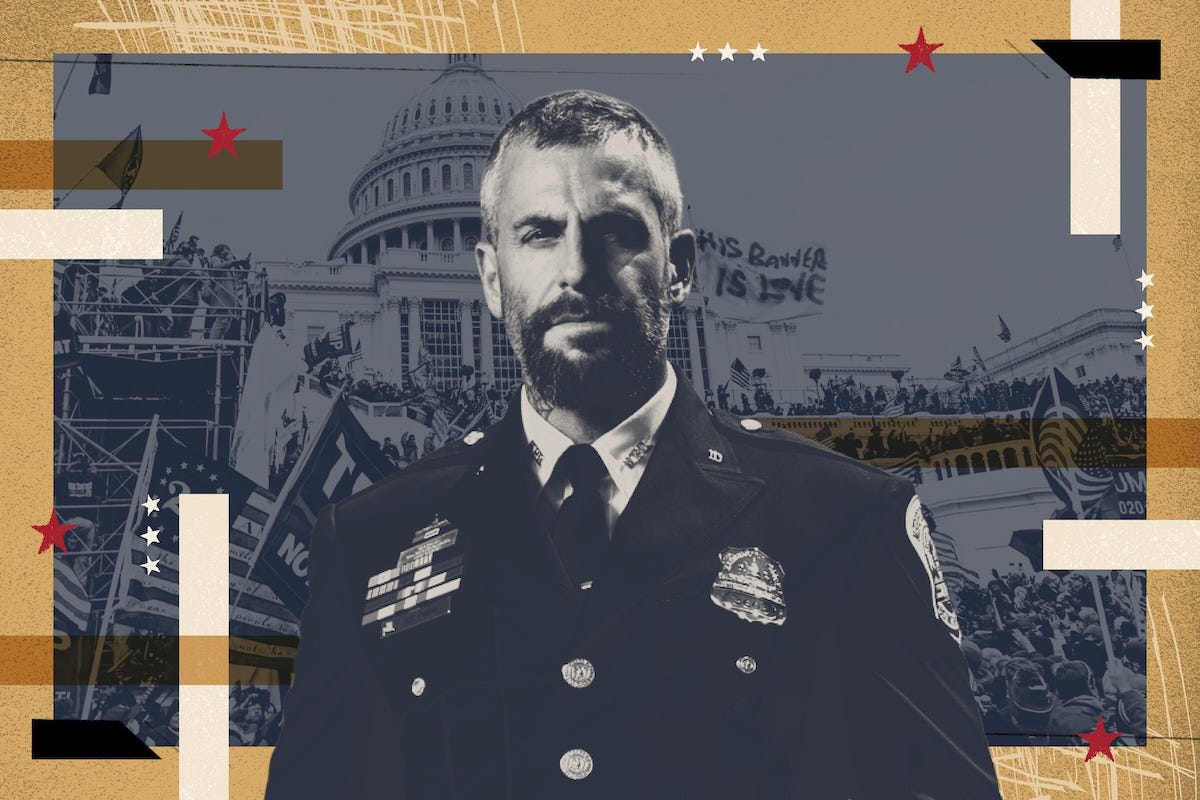
Today marks the five year anniversary since January 6. Five years since I was beaten and tased by a Trump-incited mob while defending the United States Capitol. Five years since the seat of democracy was attacked by its own citizens over the lies of one man—and countless men and women in uniform paid a violent price.
And five years later, we’re watching a full-scale attempt to rewrite history in real time. After the 2024 election, I felt something that I hoped I would never feel again after the 6—betrayal. Not just political disappointment. Betrayal. Betrayal by the American people who, after everything that occurred that day and every day since—after countless reams of footage, eyewitness testimony, and DOJ and Congressional investigations into what really happened on January 6 —saw fit to return Donald Trump to office.
And in the first week of his term, he did exactly what he promised. He pardoned the violent offenders who attacked me and my fellow officers. And it hurt. It hurt me more than any injury I suffered on that fateful day. And yeah, I was depressed, I was broken, and I didn’t know how to pick up the pieces, and didn’t even know if I wanted to anymore. If the American people saw what they saw, heard what I experienced, and still decided to vote this guy back into the highest office in the land—What was the fucking point?
But after a few weeks, and more than a few beers, that hopelessness turned to anger. And that anger turned into rage. And that rage turned into resolve. Because those who know me know this: I may have taken a beating that day, and suffered in the days and years since, but I never walk away from a fight when the facts are on my side, and I refuse to be a victim. I refuse to stand idly by while a mob’s lies are laundered into “alternative interpretations” and political convenience.
And believe me, this is the last thing I want to be doing day after day, week after week, year after year. I never envisioned myself becoming a political activist or a public figure. I loved being a cop. I loved living a normal life, where nobody knew my name, where I could do a job I was good at, and end each day with a cold beer, a walk with my dogs, and quality time with my kids. Being a cop wasn’t easy, but it brought me joy—I believed in the work, and I was good at it.
When I spoke out after January 6, I honestly thought my fellow officers would rally around me. I wasn’t making a partisan argument. I wasn’t speculating. I was telling people the truth of what happened—something I had done countless times under oath when a case I worked went to trial. And in my line of work, you focus on the evidence. You focus on the cold hard facts, and the proof beyond a reasonable doubt.
And looking at the cases I worked during my two decades in law enforcement, the amount of evidence presented to the American people in the aftermath of January 6 was something a former detective like me, and prosecutors like my old friend Glenn Kirschner, would have dreamt of having on his side in the courtroom. And don’t get me wrong, we always had the warrants and evidence that we needed when we brought a case before a judge—but nothing like this.
January 6 was documented in every way imaginable. Thousands of eyewitness testimonies. Body-worn camera footage of hundreds of officers, including myself. Radio traffic, Pulitzer Prize-winning photos, and hundreds of thousands of hours of video footage captured from people on both sides who were there that day. The burden of proof on what transpired that day couldn’t have been greater. The facts were presented. The American people saw what happened in broad daylight, in real time, with their own eyes.
Yet here we are. Five years later. People like to say, “You can’t blame folks for being scared.” Or, “People just want to get on with their lives.” Or, “Not everyone has the luxury of being outspoken.” I hear all of that. And I reject it. I absolutely blame the people who have remained quiet, or looked the other way—especially the wealthy, powerful, and well-connected—all those who chose comfort over courage—because silence isn’t neutral.
Silence is a decision—a sin of inaction. And too many people with influence decided that taking a stand was inconvenient. I don’t get that choice. I can’t opt out. I can’t “move on.” For five years, the death threats to me and members of my family have been constant. The scare tactics never stopped. The target on my back didn’t disappear after the sun rose on January 7, and in the five years since. This isn’t theoretical for me. This is personal.
Recently, I was watching “The American Revolution” by Ken Burns, and the historical parallels between the founding of this country and today are shocking. The clean version of the American Revolution—the one we were taught as kids in history books and on the big screen—was wrong. The Revolution wasn’t a unified uprising of Americans bravely standing together from the very beginning against tyranny. It wasn’t simple. It wasn’t neat.
Large portions of the population sided with Britain. Not because they loved oppression, but because they valued comfort and stability. A “devil you know” mentality, where law and order outweighed personal and collective liberty, as colonies were used and abused by a kingdom many of them had never even seen. Meanwhile, Americans paid taxes they didn’t vote for. Lived under leaders they didn’t choose. But the colonies were fractured, plagued by infighting and cultural differences.
So for most of the war, many of the American people buried their heads in the sand and said, “I don’t want to risk it,” and even when the fighting began, either sided with the British or paid the poor to fight in their stead. And 250 years later, we’re back where we started. People are tuned out. Overwhelmed. Manipulated by the powers that be, as every hungry mouth and outstretched hand is fed by empty promises and lies as political will shrinks, and the soul of America starves.
And whether the American people fully believe those lies or not, too many find it easier to blame the poor and vulnerable migrants for their struggles, instead of the wealthy few who could pass laws tomorrow that guarantee universal healthcare, address the affordability crisis, fix our broken immigration system, hold those who perpetrated violence against their own nation to account, and reignite the American dream we were all promised by those who came before.
It’s easier to punch down than look up. But the course of history isn’t changed when most people wake up. It changes when enough people refuse to shut the fuck up. People like Samuel Adams. Sam understood the power of narrative. He didn’t wait for the next election. He didn’t wait for permission. He owned a print publication, and his newsletters were relentless. Every British atrocity was documented, labeled plainly, and put in front of the public—on street corners, on doorsteps, in towns and cities across the colonies.
Every killing of innocents was called what it was: a massacre, when people were tired and wanted to look away. People like him kept the flame alive when hope seemed lost. And George Washington did the same. Loss after loss. Death after death. He was underfunded, outmanned, betrayed by the people he trusted most not just once, but multiple times. And nevertheless, he persisted. He didn’t just show up, he charged forward when others fled.
As flawed as he was, he led by example in the moments where it counted most. His conviction carried people through violence that should have broken them. And instead of caving to authority and falling for cheap comforts, he renewed their spirits. He made them feel hopeful and ready to fight, no matter the cost. Faith. Resilience. Sacrifice. That’s how change actually happens.
And there are people doing that today: independent journalists like Don Lemon and Jim Acosta. Fellow January 6 officers like Daniel Hodges, Aquilino Gonell, and Harry Dunn. The thousands of anti-Trump, pro democracy influencers, activists, lawyers, judges, and even some politicians. We’re still here. We’re not capitulating to corporate interests. We’re not waiting for permission. We’re not pretending this will fix itself if we just stop paying attention.
If there’s one glimmer of hope I hold onto, it’s this: Trump and his corrupt administration aren’t driven by ideology. They’re driven by ego. By the whims of one narcissistic man who capitalized on the rightful frustration of everyday Americans and weaponized it—turning grievance into power through lies, empty promises, and a cult of personality.
That kind of movement doesn’t last forever. It only lasts as long as we the people remain hopeless. Taking a stand in America has always been messy, exhausting, and lonely. But you always miss the shots you never take. And five years after January 6, that’s what fuels my fire. That’s what gets me out of bed each day to speak out and resist. Not because it’s easy. Not because I chose this. But because walking away was never an option.
Michael Fanone is a former police officer who defended the Capitol on January 6. He is an Advisory Board Member and Spokesman for Home of the Brave, a new initiative highlighting the harms of Donald Trump’s second term. This essay originally appeared on his Substack, which you can subscribe to here.
I'm a police officer in Michigan. I'm surprised at how emotional and introspective about my job I feel today. And how alone I feel in that sentiment. In my own department, we'll often get emails from our command staff on days of remembrance thanking us for what we do or encouraging to embrace each other, etc. I don't expect we'll get one today and that makes me angry. Of the many things to be angry about from that January 6th, what makes me angriest is how what happened to you and your coworkers has been swept aside and forgotten.
Michael, please know that you and your coworkers from the Capitol are not forgotten. And, in whatever way I can, it would be an incredible honor to try and fight this fight alongside you and anyone else willing to do so, be it in large or small ways.
To everyone else, if anyone tells you that Trump and the Republicans are pro law enforcement, I've found that reminding them of how Michael and his colleagues have been treated is an effective way of exposing that infuriating bullshit.
Thank you Michael for your courage to keep going everyday and keep fighting the atrocities that happened 5 yrs ago against you, your colleagues and our Capitol. We are truly grateful for your service and I look forward to hearing more from you. Please...don't give up.