


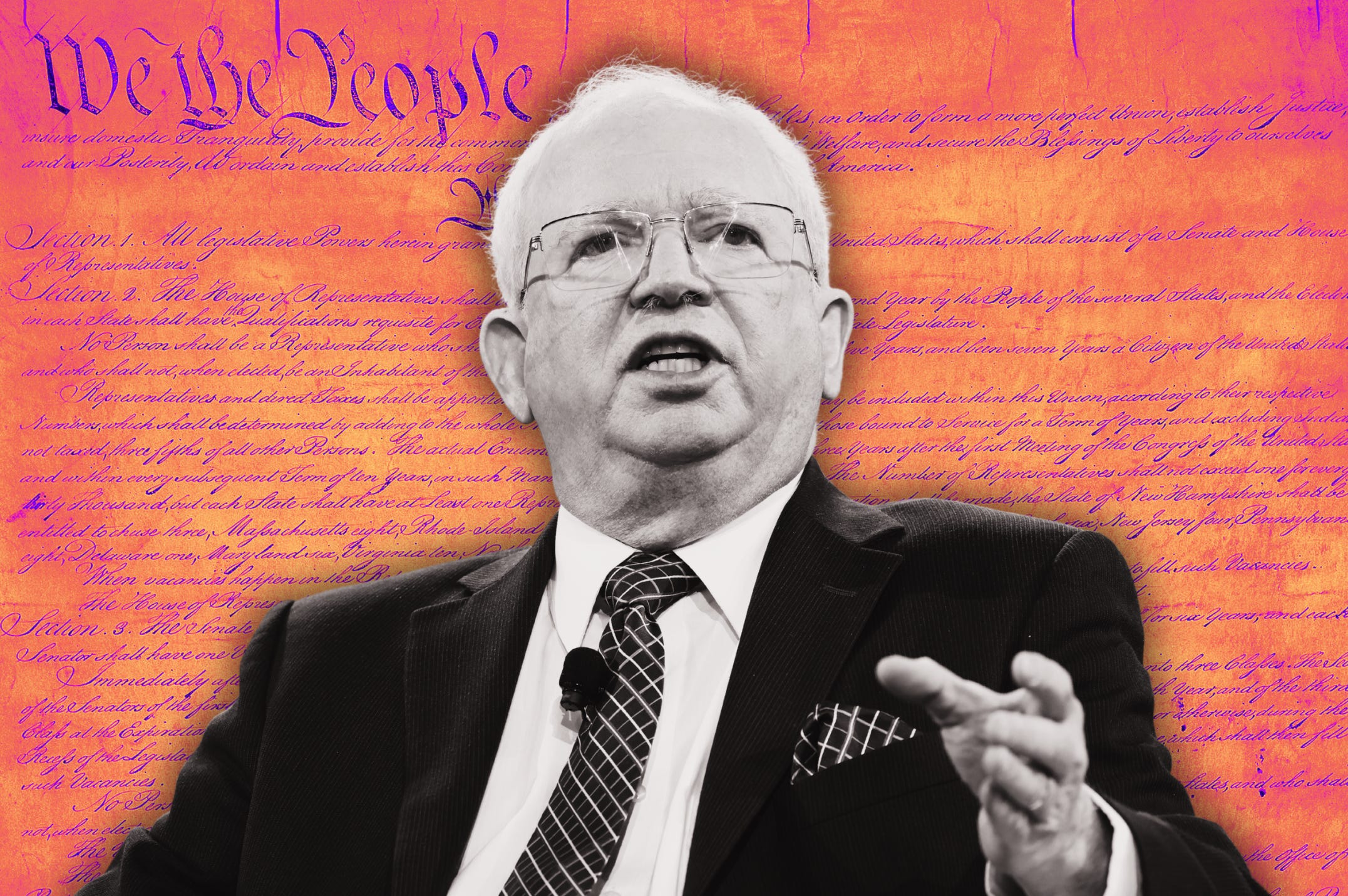
On Tuesday, the Supreme Court issued its long-awaited ruling on birthright citizenship. Five justices, led by Chief Justice John Roberts, ruled that President Donald Trump’s Executive Order, “Protecting the Meaning and Value of American Citizenship,” violates the 14th Amendment to the U.S. Constitution.
Legal observers had long expected that the order would be overturned by the nation’s highest court, as birthright citizenship is well-grounded in both legal and historical precedent. But those precedents didn’t stop the Trump administration from attempting to restrict the rights of American-born babies. Instead, the administration relied on arguments that were once fringe—ideas similar, if not identical to, those advanced by a conspicuous source: John Eastman.
Eastman, a conservative lawyer, previously played a prominent role in Trump’s efforts to overturn the results of the 2020 presidential election. As part of that scheme, he argued that Vice President Mike Pence had the power to deny the certification of Joe Biden’s victory during the January 6, 2021, joint session of Congress. Pence and his closest advisors correctly concluded, however, that Eastman’s arguments were unconstitutional, lacking any basis in law or historical precedent.
Pence steadfastly resisted Trump’s pressure to act in his favor, and against his constitutional oath, on January 6th. The former vice president later decried the influence of “crackpot lawyers” surrounding Trump at the time. Long before the 2020 election, Eastman repeatedly argued that the 14th Amendment was being misinterpreted. And Trump’s Executive Order, now invalidated by the Supreme Court, echoed Eastman’s key argument.
Some background is in order: The Citizenship Clause of the 14th Amendment reads: “All persons born or naturalized in the United States, and subject to the jurisdiction thereof, are citizens of the United States and of the State wherein they reside.”
Trump’s Executive Order focused on the middle part of that sentence, specifically the words “and subject to the jurisdiction thereof.” As the Supreme Court’s majority made clear, the word “jurisdiction” has always meant the power of the United States to govern those within its physical territory. This definition has stood since the 19th Century. Therefore, if a baby is born inside the United States, then the child is subject to its “jurisdiction.” Full stop.
But Trump’s Executive Order attempted to narrow this longstanding definition of “jurisdiction” to exclude all babies born to mothers unlawfully or temporarily present inside the United States (including those mothers here on student, tourist or work visas) and whose fathers are not U.S. citizens or permanent residents at the time of the babies’ births. According to the Trump administration’s reinterpretation of the 14th Amendment, such parents were still supposedly under the jurisdiction of foreign sovereign powers, not the United States government, and therefore their American-born children were not owed birthright citizenship. Got all that?
Eastman has been making this same ahistorical argument for decades.
In September 2005, for instance, Eastman testified before Congress on the subject. His written testimony was titled: “Born in the U.S.A.? Rethinking Birthright Citizenship in the Wake of 9/11.” Much of his 17-page statement focused on the same phrase at the heart of Trump’s E.O.—“and subject to the jurisdiction thereof.” Eastman claimed there was a “distinction between partial, territorial jurisdiction, which subjects all who are present within the territory of a sovereign to the jurisdiction of its laws, and complete, political jurisdiction, which requires as well allegiance to the sovereign.” He claimed that the “more complete, allegiance-obliging jurisdiction” was “codified” in the Fourteenth Amendment and, therefore, the babies of mothers in the United States unlawfully or temporarily were not owed birthright citizenship.
A majority of Supreme Court justices rejected this same argument in their ruling, finding that the word “jurisdiction” means territorial jurisdiction and not some broader “allegiance-obliging jurisdiction,” as imagined by Eastman.
“The Citizenship Clause uses jurisdiction in its ordinary sense—referring to the power of the United States to govern those within its territory,” Roberts writes. The chief justice explains that the “scope of that power,” as well as the meaning of “jurisdiction,” was “well settled in 1868,” the same year the 14th Amendment was ratified. And the “children born of parents unlawfully or temporarily present in the United States” fall within this jurisdiction. “Under the Constitution, they are citizens at birth.”
Roberts’ ruling, joined by four other justices, is a direct repudiation of Eastman’s argument, and decades of his work.
As Politico’s Josh Gerstein has reported, “Eastman has been advancing his fringe interpretation of the 14th Amendment since 2005, racking up more than 100 op-eds, interviews, law review articles, debates, speeches and legislative hearings.” Eastman’s advocacy continued through the first Trump administration.
Bill Barr, Trump’s attorney general from 2019 to 2020, later told the House Select Committee to Investigate the January 6th Attack that he met with Eastman to discuss birthright citizenship. “The President cited that, him [Eastman] to me, as, you know, someone who had this great idea about how you could eliminate birthright citizenship by executive order, and I told him I thought that was wrong,” Barr told the committee. “And he [Trump] kept on invoking Eastman.”
Barr continued: “So I asked Eastman to come over to my office and explain this to me, and I think he did a very good job of it. And when he left, he said, you know, I think you’re right. That would be the wrong thing to do. And, you know, it wouldn’t really work legally and practically. And I said, well, be sure and tell that to the President. And that was my last discussion with Eastman.” (Eastman later disputed part of Barr’s characterization.)
Ultimately, Trump did not take Eastman up on his suggestion during his first term. The president did not attempt to restrict birthright citizenship until after he was inaugurated for a second time. But Trump clearly considered it.
On October 31, 2018, Trump tweeted (emphasis added): “So-called Birthright Citizenship which costs our Country billions of dollars and is very unfair to our citizens will be ended one way or the other. It is not covered by the 14th Amendment because of the words ‘subject to the jurisdiction thereof.’ Many legal scholars agree.....” He then followed up with another tweet, in which he vowed: “This case will be settled by the United States Supreme Court!”
Trump was right that the case would be settled by the Supreme Court—just not for several more years. Still, Eastman’s argument concerning the meaning of the word “jurisdiction” had clearly made its way to Trump.
When Trump finally did issue his executive order, on the first day of his second term, Eastman was “so elated that he told a reporter he’d been tempted to pour Gatorade over his head.” And as the head of the Claremont Institute’s Center for Constitutional Jurisprudence, Eastman filed an amicus brief in support of Trump’s Executive Order. In it, Eastman reprised his argument about the meaning “jurisdiction”—an argument now rejected by the Supreme Court.
There is more to the legal ins and outs than have been covered here. But the bottom line is that Eastman’s arguments have not carried the day in the courts. His effort to overturn the 2020 presidential election’s results failed. And now his decades-long quest to overturn birthright citizenship has failed as well. In both instances, the U.S. Constitution held.
Tom Joscelyn is the principal author of the House’s January 6 report and a widely recognized expert on extremism issues. He co-hosts Home of the Brave’s new podcast, “It’s Happening Here,” which you can find wherever you get your podcasts.

John Eastman was disbarred by the State of California for his attempt to dissuade Mike Pence from certifying the 2020 election.
Any Day Eastman is repudiated is a good day.