


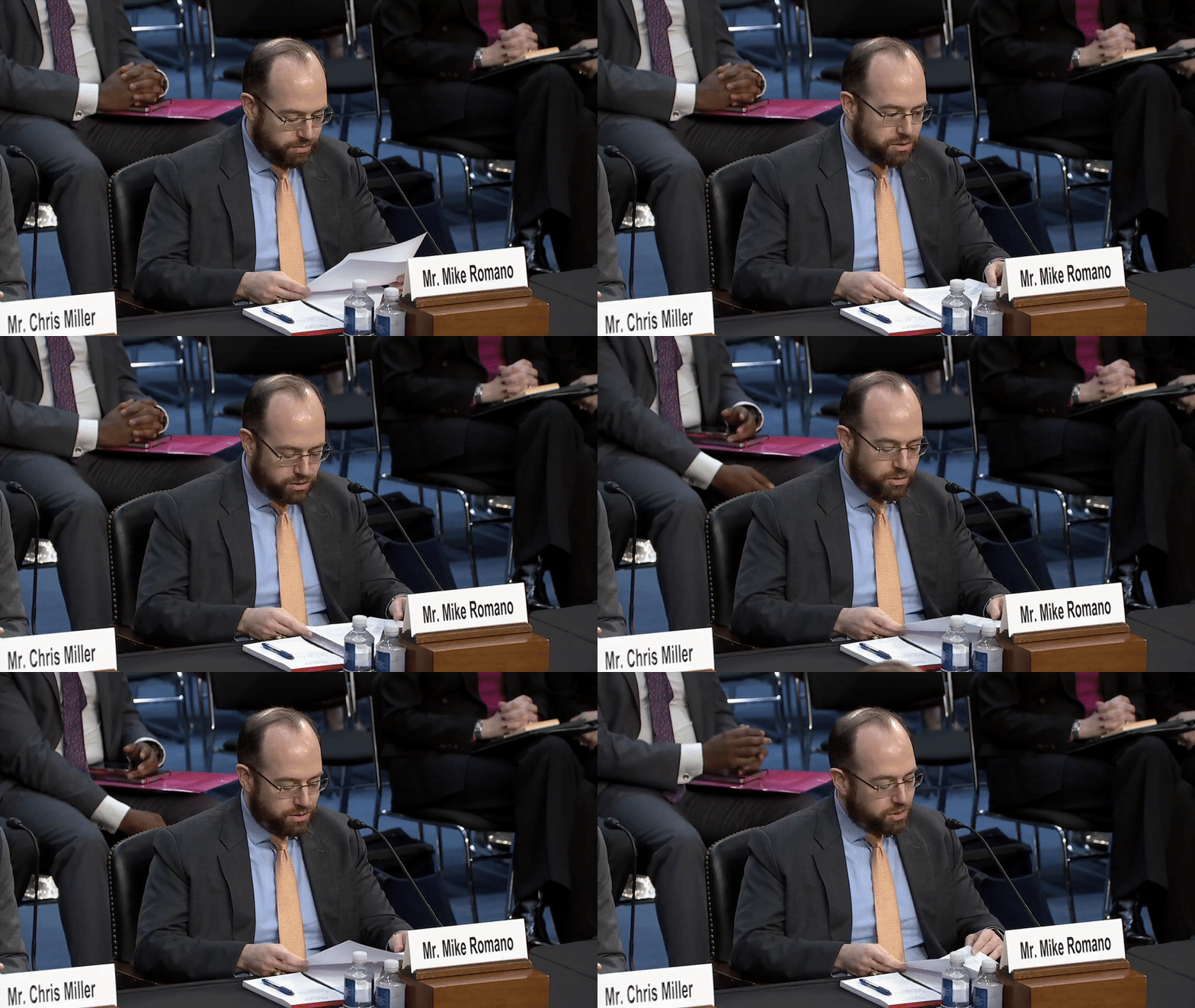
Until March 2025, I served at the Department of Justice. I spent four years in the Capitol Siege Section, which investigated, charged, and convicted hundreds of violent rioters after the January 6 insurrection. For most of that time, I was one of the unit’s Deputy Chiefs.
That event will forever stand as a black mark in American history. Yet Donald Trump and his enablers have now spent five years lying about what happened that day. They’ve lied about Special Counsel Jack Smith’s role in investigating Trump attempts to overturn the election. And they’ve lied about those of us who had a hand in seeking justice throughout this dark, undemocratic period of our nation’s history.
As Trump’s second term started, I immediately realized I couldn’t serve honorably or faithfully in such an administration. As I told The New York Times Magazine at the time I stepped down: “Anyone who spent any time working on January 6 cases saw how violent a day that was … It’s incredibly demoralizing to see something you worked on for four years wiped away by a lie … Then the pardons [of all January 6 defendants] came down and I knew, in light of that, there is no way I can stay.” So I left after almost 18 years on the job.
Since then, I’ve been called to testify on Capitol Hill three times, most recently this past week. The topic: “Arctic Frost,” the joint federal investigation into Trump’s attempts to overturn the 2020 election. Trump’s supporters in Congress are now trying to re-write the history of that effort, and the president’s abhorrent conduct that triggered it. To do so, they’re holding hearings like the one I just testified at: “Arctic Frost Accountability: Oversight of Telecommunications Carriers’ Responses to Jack Smith’s Witch Hunt.” (No points for subtlety.)
The hearing centered on toll records, which are records that show that a phone number called another phone number, when the call was placed, and how long it lasted. These are common pieces of evidence for investigators to collect, and the Special Counsel’s office did so as part of its investigation. Some Senators had their toll records collected, which is understandable: many of them were regularly in contact with Trump, or his supporters, at the time of Trump’s alleged crimes. Predictably, Senators are mad that their records were collected; but their anger doesn’t mean that anything nefarious happened here.
Some Senators were also extremely unhappy about nondisclosure orders, which are intended to keep the contents of an investigation confidential while it is ongoing. For obvious reasons, in this case, such confidentiality was essential. After all, the sitting president had just sicced a mob on the Capitol, which sacked the place, threatened lawmakers’ lives, and bludgeoned police officers. Confidentiality was a must. But Trump’s supporters have another word they like to use for this kind of standard investigative practice: “weaponization.”
This hearing was a sham, full stop. It was obvious from the title of the hearing, and it was even more obvious after Sen. Marsha Blackburn’s (R-Tenn.) opening statement, in which she called Jack Smith’s investigation of Trump’s election interference “the worst weaponization of government in American history.”
But I was invited to give my perspective to the gathered lawmakers, and I did so willingly. If Trump’s supporters are going to poison our information stream with lies and conspiracy theories about January 6, the investigation into Trump, and the conduct of DOJ personnel like me and my colleagues—well, I’m not about to let that go unchallenged. That’s why I chose to testify, speaking for five and a half minutes and calmly setting the record straight about all of these matters. As expected, my comments were neither welcome nor appreciated by Trump’s supporters on the Committee.
WATCH: Mike Romano’s Congressional Testimony
“Madam Chairman, could you ask the witnesses not to filibuster us into Friday?” said Sen. John Kennedy (R-La.), after cutting me off mid-sentence. “I’ll gladly do so,” said Sen. Blackburn. I was not allowed to finish my statement.
But I’m not going to let them re-write our history in real time. Sen. Blackburn wouldn’t let me speak my full remarks, but I know there are plenty of people out there who care about countering flagrant lies with truth. For that reason, I’m sharing my Congressional testimony in full, below.
For those who feel the same as I do, good. We’re in for a long fight. But it’s one worth fighting.
Good morning Chairman Grassley, Ranking Member Durbin, and members of the Committee. Thank you for the opportunity to discuss the Special Counsel’s election interference case, codenamed Arctic Frost, and his office’s collection of toll records. It is an honor to speak with you today.
My name is Michael Romano. I was an attorney in the Department of Justice for almost eighteen years. Immediately before my resignation, I was a Deputy Chief of the Capitol Siege Section here in Washington, D.C. It was a great privilege to serve the United States by prosecuting crimes committed during the violent riot at the U.S. Capitol on January 6, 2021.
When I first learned of this hearing, I was surprised. Surprised because, from my perspective as a long-serving federal prosecutor, there is nothing remotely scandalous or controversial about the collection of toll records.
Let me be specific about what toll records are, and what I understand they involved in the election interference case. Toll records show that a phone number called another phone number, when the call was placed, and how long it lasted. They do not include content. They do not capture conversations, voice mails, or text messages. When the Special Counsel’s Office collected toll records, it did not gain access to anyone’s thoughts or to any private discussions—only to the fact that the calls happened.
Subpoenas for toll records are routine in criminal investigations, especially where those investigations involve conspiracy and obstruction of justice. Both of those crimes turn heavily on a person’s intent, which makes their communications especially important. In such cases, investigators and prosecutors often seek to understand who the target of an investigation spoke with, when, and for how long. Investigators and prosecutors may also seek to understand who other people spoke with, even if those other people are not suspected of any criminal wrongdoing.
Nondisclosure orders are also routine. It is often best practice for investigations to be conducted as covertly as possible. That is especially important where there are concerns of tampering, witness intimidation, or attempts by key parties to get together and agree on a story, which, based on what I know of the Special Counsel’s election interference case, was a real concern. After all, critical witnesses—which may have included some of you, Senators, and your colleagues—did have their lives threatened on January 6 by supporters of the President.
This collection of toll records was not weaponization. It was not a witch hunt. It was not a pretext to harm enemies. If this was any of those things, the Special Counsel would have used this information against you, somehow. But as I understand, that didn’t happen. His office followed Department policy in the collection of evidence. I understand that it safeguarded that evidence, keeping it confidential, just as I would expect any federal prosecutor to do. I understand that some of you had your toll records collected and that you are unhappy about that. That is understandable: nobody enjoys having the government collect their information. But apart from that unhappiness, you were not harmed.
Indeed, given the gravity of the crimes under investigation in the election interference case, the Special Counsel needed to investigate fulsomely. Remember what we were dealing with, after January 6. The Capitol had been ransacked by a violent mob. Throughout the grounds and building, police officers were assaulted. They were punched, kicked, tackled, and spat on, battered with poles, hit with chairs, crushed in doors, blasted with pepper and bear spray, and shocked with stun guns. The rioters stormed the building, causing millions of dollars of damage to the seat of our government. They tried to overturn the results of the election and, by force or threat of force, install their preferred candidate despite the outcome. And in the process, your lives, your staff members’ lives, and the lives of the officers who protected you were put in danger.
This crime demanded to be investigated. Working as part of the Capitol Siege Section, prosecuting rioters, and having a role in leading the effort, was the apex of my work in the Department of Justice. It is the most righteous effort I have been a part of, with the finest team of prosecutors I have worked with. It was an honor to serve my country and do this work. President Trump’s role in the election interference case deserved to be investigated, too, and it merited all of the tools available to federal investigators and prosecutors.
Mike Romano served as a Deputy Chief for the Capitol Siege Section in the US Department of Justice. He resigned in March 2025, after nearly 18 years of service.

Thank you so very much for your bravery and for your love of country!
Thank you, Mr. Romano, they were lucky to have you for all those years!