


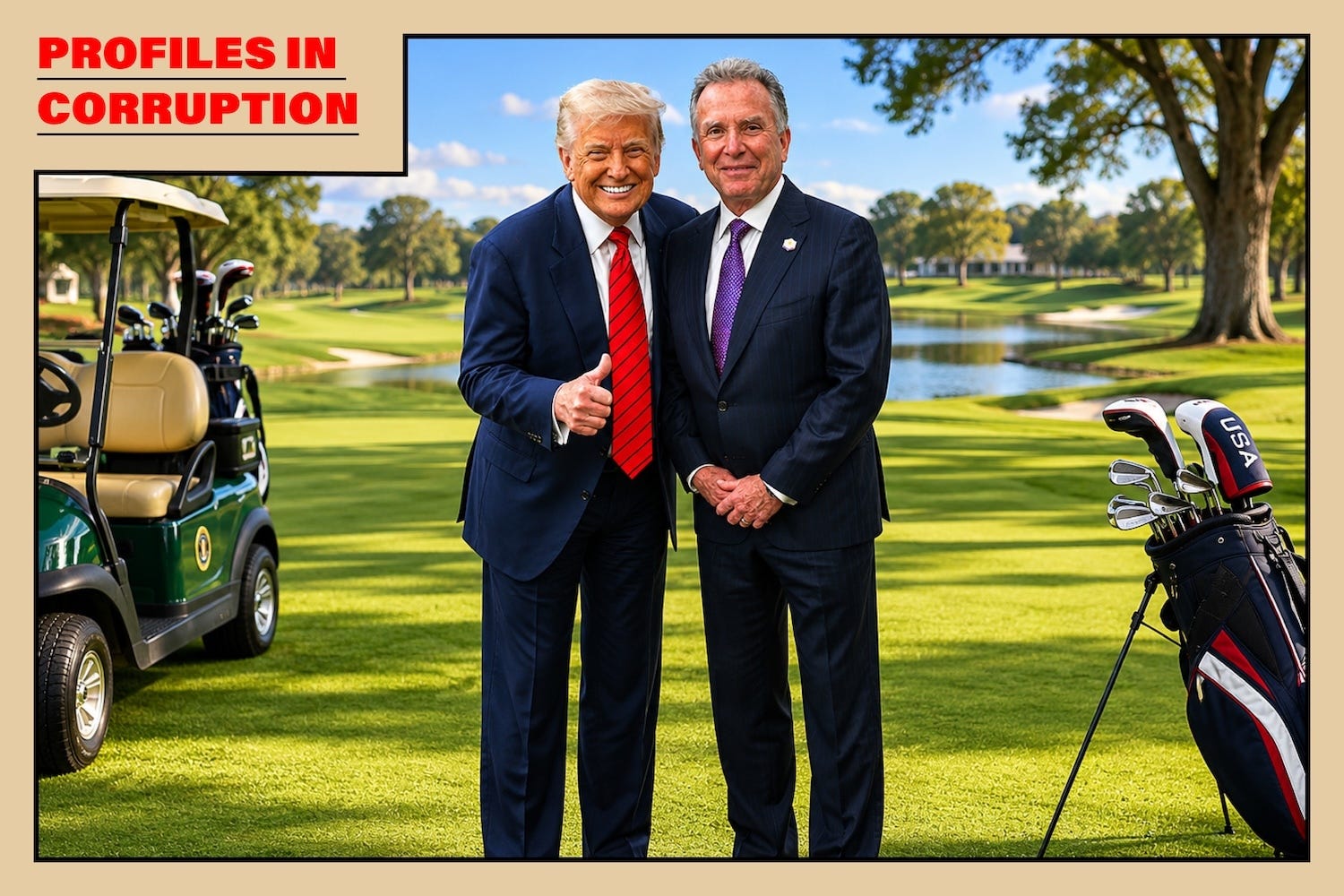
This article is Part Four in a series called ‘Profiles in Corruption,’ in which we shine a light on the personal financial interests of people close to the president. Previously, we profiled Don Jr., JD Vance, and Jared Kushner.
The Trump administration’s “largely negotiated” peace deal with Iran is a cut-and-run solution that, in substance, is far less favorable to the United States than the Obama administration’s 2015 Joint Comprehensive Plan of Action—which, famously, Trump spent the past decade railing against. It’s been well-documented at this point that Trump is an inept negotiator and a lousy dealmaker.
But now, with the ink drying on a deal to end a war no Americans asked for, it’s time we examine one of the other key figures behind this whole debacle. This man is not the Secretary of State. He was not confirmed by the Senate. Not a single ethics official signed his financial disclosure. He appears to answer only to the president.
This man is Steve Witkoff.
What are his qualifications? He is a real estate developer from New York, and he is Donald Trump’s golf buddy. His net worth is $2.3 billion and rising—it was closer to $1 billion in January 2025. And he emerged as a key diplomatic figure in Trump’s administration despite—or perhaps because of—his sprawling business ties around the globe.
The Disclosure that Nobody Certified
When a person takes a high-level government job—when they become a Cabinet secretary, an ambassador, or a senior White House official—they go through a process. They file detailed financial disclosure forms. An ethics office reviews those forms. Officials certify that the person has either divested conflicting assets or obtained a waiver. The whole point is simple: if you are in a position to act on behalf of the country, such as representing the United States in negotiations with foreign governments, the American public deserves confidence that you will not be blackmailed or otherwise beholden to conflicting financial interests.
Witkoff is not playing by those rules. He began working as Middle East envoy in January 2025, but he signed the form saying he held no other federal position during the 12 months before the form was filed on August 13, 2025. At the time of filing the form, Witkoff disclosed some of his financial dealings, like the selling of his $120 million stake in his company to alleviate any potential conflict of interest.
One interest Witkoff’s disclosure form did not detail is his continuing assets in World Liberty Financial, the cryptocurrency company he started with the Trump family in 2024. The White House counsel, David Warrington, said in January 2026 that Witkoff is “taking steps to divest from World Liberty Financial.” Will we ever know how much Witkoff owned? Issues like these call into question the reliability of Witkoff’s financial disclosure—and, by extension, his honesty as a broker of the United States’ interests.
The rules about financial disclosures may be tedious, but they exist for a reason. They ensure that the senior government employees serving our country are able to carry out their duties while avoiding conflicts of interest. Witkoff’s form lists his start date as June 30, 2025—never mind the five months he’d already spent representing the administration in the Middle East. If he can’t get a verifiable date right, why should we trust him to negotiate nuclear policy with our adversaries?
Most glaringly, no ethics official signed his disclosure. In case you were wondering, that is not normal. Donald Trump, JD Vance, Marco Rubio, Howard Lutnick, Pete Hegseth, RFK Jr.—all these men submitted financial disclosures. All were signed by at least one ethics official. But Witkoff’s was not.
Several Democratic senators wrote letters to the White House raising concerns about Witkoff’s potential financial conflicts of interest. They point out that Witkoff advocated the export of advanced AI chips to the United Arab Emirates around the same time a UAE-backed government firm invested $2 billion in World Liberty Financial’s stablecoin. (We covered this story in our profile of Don Jr.)
Three ethics lawyers told the New York Times that questions about potential ethics violations are “particularly relevant” to Witkoff. Sens. Elizabeth Warren (D-Mass.) and Chris Murphy (D-Conn.) say this pattern suggests that “the two deals may have been ‘intertwined’: support for the valuable chips export deal in exchange for a lucrative investment.”
Why Can’t He Just Disclose?
We are not asking Witkoff to stop being rich. But we are asking him to do what every other senior official in the American government is required to do: provide a certified, verified, complete accounting of what he owns and what he owes—reviewed by people whose job is to catch conflicts.
That process exists because it tells the public: This person is working for you, not for themselves and not for foreign nations. Witkoff’s form has never gone through that process. No ethics officer signed it. No one confirmed it covers the right time period. And as of the last filing, it still showed active stakes in a crypto company taking billions from the very countries with whom he was negotiating.
If Witkoff has nothing to hide, why does he seem to be hiding so much?
Home of the Brave exists to show Americans the real-world consequences of this administration’s policies, and to highlight what bravery looks like in defense of American democracy.
To know Trump is to take part in the grift that is now part of everyday government business.