


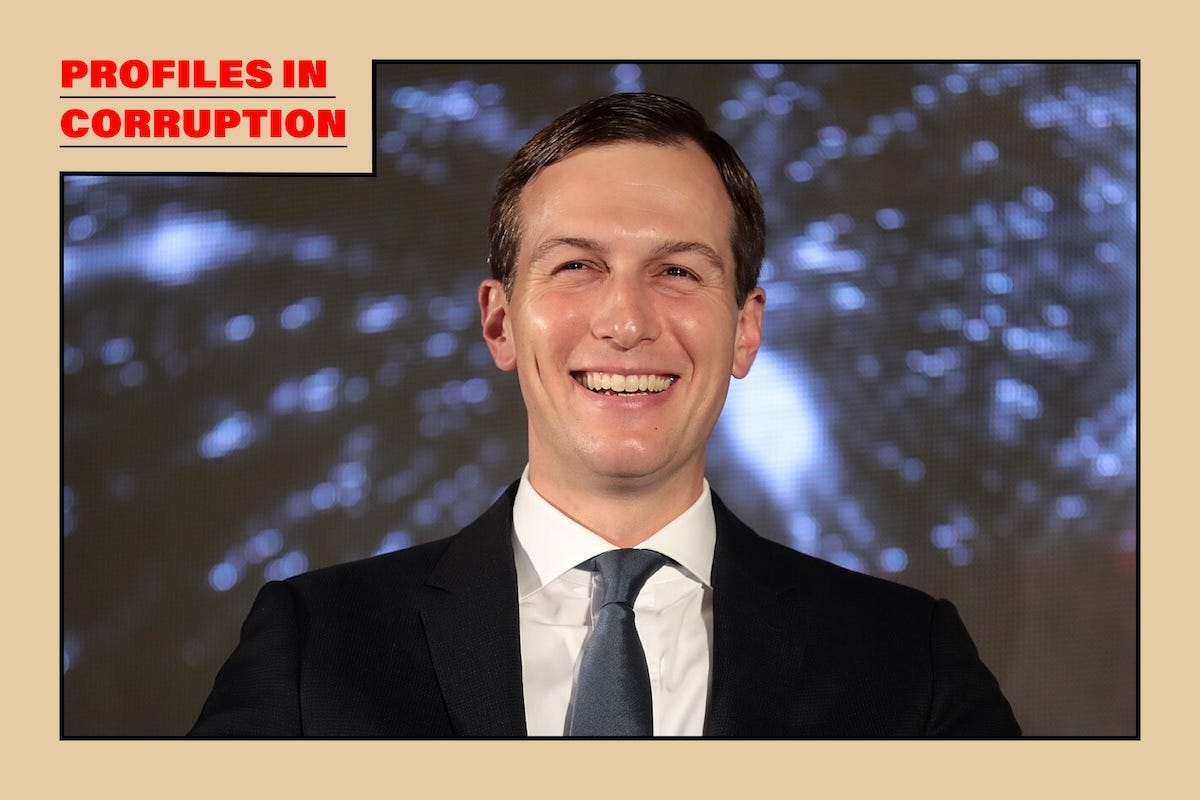
This article is Part Three in a series called ‘Profiles in Corruption,’ in which we shine a light on the personal financial interests of people close to the president. Previously, we profiled Don Jr. and JD Vance.
Before Jared Kushner became a billionaire, he was the wealthy son of a New York real estate magnate and paid next to nothing in federal income taxes for several years running. The New York Times reported that between 2009 and 2016, Jared Kushner utilized real estate depreciation rules to avoid cutting checks to Uncle Sam. Kushner’s wealth quintupled from around $64 million in 2008 to $324 million in 2018.
The wealth he has accumulated since 2018 is even more staggering. Leveraging the rolodex he accrued as an advisor in the West Wing, Kushner launched a private equity firm in 2021 called Affinity Partners and quickly secured lucrative investments from abroad. In four years, he turned Affinity Partners into a $4.8 billion enterprise.
When you add up Kushner’s 100 percent ownership stake in Affinity, his 20 percent stake in Kushner Companies (his family’s real estate business), his $105 million dollar home in Florida, and his collection of artwork, cash, and other personal investments, Kushner’s total net worth now exceeds the three comma benchmark. He officially became a billionaire in September 2025.
Before we unpack how Kushner amassed his fortune, let’s ask: Why does this matter?
It’s not illegal for the president’s son-in-law to become rich; we are not alleging that Kushner has committed any crime. But since Kushner became a senior advisor in Trump’s first administration and an unofficial negotiator in the second, his business activity warrants close scrutiny. And his sprawling web of business deals with Middle Eastern governments raises concerns about whether Kushner can negotiate in good faith on behalf of the United States government.
Kushner’s story is part of a pattern: people in Trump’s inner circle are monetizing their proximity to the president and obtaining financial gains that wouldn’t exist without that access. The American people are left wondering whose interest is driving the administration’s policy decisions: the public’s interest, or the personal financial interests of the president’s friends and family.
Before he was part of the Trump family, Kushner was a scion of a different New York City real estate empire. Jared Kushner’s father, Charles Kushner, started a real estate development firm in New York in 1985. But in 2005, Charles Kushner was found guilty of federal tax violations and an attempted plan to blackmail his brother-in-law by hiring a prostitute to seduce him, secretly film the encounter, and send the video tape to Kushner’s own sister, the man’s wife. The elder Kushner was sentenced to 24 months in federal prison. (As an aside, Donald Trump pardoned Charles Kushner in 2020. Today, Charles Kushner serves as the United States Ambassador to France and Monaco.)
While Charles Kushner was serving his time in jail, Jared was called up to run the family’s real estate business. At the time, he was a joint law-M.B.A. student at NYU, and he was dating Ivanka Trump. He and Ivanka got married in October 2009
Fast forward to 2017. His personal wealth had grown substantially, in part due to his savvy navigation of federal income tax rules as discussed above. His father-in-law became the President of the United States, and Kushner served as a senior White House advisor and Middle East envoy. This role was unprecedented for someone with no government experience, no Senate confirmation, and no apparent expertise in foreign policy. He was the architect of the Abraham Accords, the 2020 agreements that normalized diplomatic relations between Israel and the United Arab Emirates, Bahrain, Sudan, and Morocco. In the process, he built close personal relationships with the leaders of several Gulf states including Saudi Crown Prince Mohammed bin Salman, known popularly as MBS.
When Washington Post journalist Jamal Khashoggi was murdered in the Saudi consulate in Istanbul in 2018, US intelligence agencies concluded MBS ordered the killing. Kushner was, according to the New York Times, a key defender of MBS inside the White House—helping ensure the relationship between Kushner’s country and MBS’s survived. (Kushner also reportedly communicated with MBS through WhatsApp to conduct official business—a breach of protocol that presaged Signalgate.)
The $2 Billion Question
Six months after leaving the White House in January 2021, Kushner secured a $2 billion investment from Saudi Arabia’s Public Investment Fund, the country’s sovereign wealth fund, for Affinity Partners, his newly formed private equity firm.
Here’s what makes that remarkable: Saudi Arabia’s own investment board didn’t want to do it. According to the New York Times, a review panel that screens investment for the main Saudi sovereign wealth fund flagged Affinity Partners for inexperienced management, unsatisfactory due diligence, excessive management fees, and, in their words, “public relations risks” tied to Kushner’s White House role. Despite these concerns, Crown Prince MBS overruled the panel and approved the deal.
Also, interestingly, Kushner was not the only former Trump administration official soliciting investments from the Saudi sovereign wealth fund at the time. Steve Mnuchin, the Treasury Secretary during Trump’s first term, was also starting a new fund. Mnuchin, a man with decades of finance experience, received a $1 billion investment from the Saudi Public Investment Fund, setting off alarm bells in Congress. Despite acknowledging the risks and concerns in investing in Kushner’s firm, the Saudis wound up investing twice as much money in Kushner’s firm as they did Mnuchin’s.
The Gulf money kept coming for Jared. Qatar’s sovereign wealth fund and the Abu-Dhabi based firm Lunate combined to invest $1.5 billion into Affinity Partners in 2024. Today, Affinity manages roughly $4.8 billion in assets—the majority of it from the same Gulf countries whose leadership Kushner courted while serving as a US official.
Congress noticed. In 2024, Rep. Jamie Raskin (D-Md.) and Sen. Ron Wyden (D-Or.) called on then-Attorney General Merrick Garland to appoint a special counsel to investigate Kushner and Affinity Partners for potential violations of the Foreign Agents Registration Act. They alleged that Kushner was simultaneously acting as a “political consultant” to Trump and as what they called a “shadow diplomat” for Saudi, Emirati, and Qatari interests—while collecting tens of millions in management fees from those same governments.
After the 2024 election, when Republicans took control of Congress and the White House, the investigation into Kushner fizzled out.
The Bottom Line
Today, Jared Kushner is traveling the world—as an unelected, not-officially-appointed official—actively shaping US government policy. At the same time, he is soliciting funds for his own private equity business. In the Middle East especially, the countries with whom Kushner’s firm, Affinity Partners, is negotiating are greatly impacted by American foreign policy. Kushner’s participation in nuclear negotiations with Iran is well-documented. At least three separate reports suggest that Kushner told his father-in-law that Iran was using the negotiations to “buy time,” which encouraged Trump to order airstrikes targeting Iran’s senior leadership.
Given his financial interests in the region and his close relationships with senior government officials in Gulf countries, Kushner cannot be trusted to negotiate on the United States’s behalf in good faith. He cannot be relied upon to offer judicious, unbiased advice to his commander-in-chief. And given his proximity to the president, we cannot trust that other countries view their investments in Kushner’s private equity firm purely through a financial lens.
With Kushner, geopolitics, personal financial interests, national security and U.S. foreign policy are inextricably linked. Right now, he is purporting to represent the interests of all Americans as a de-facto diplomat, while so much of his personal wealth is linked to related government policy decisions. That’s a conflict of interest in plain sight. The least he could do is abide by public financial disclosure rules, as executive branch officials and presidential appointees have done for decades. He could attempt to dispel the public’s doubt about potential conflicts of interest. Instead, Kushner insists he’s just a “volunteer” helping out the government; as a result he is exempt from the usual financial disclosure laws.
Still, Kushner continues to hold a murky, unofficial role in Trump’s administration. This allows Kushner to legally negotiate with foreign countries on the president’s behalf while seeking investments from foreign countries’ sovereign wealth funds for his private business. We have to wonder what is guiding Kushner’s actions: his private financial interests or the public interests of the United States? We have to wonder if our government’s foreign policy is being exchanged for private investment into the president’s son-in-law’s private equity firm.
Yesterday, Rep. Jamie Raskin, ranking member of the House Judiciary Committee, wrote the following to Kushner: “You are now reportedly participating as ‘Special Envoy for Peace’ in negotiations on behalf of the United States government to address the roiling conflicts in the Middle East. At the same time, you are soliciting billions of dollars from Gulf Monarchies for your private business ventures while already managing billions of dollars of their money in your international investment firm ... To whom do your professional obligations and fiduciary duties belong?”
It’s a good question. If what’s best for Kushner’s bottom line is at odds with what’s best for the American people, can Kushner be trusted to faithfully defend the interests of the United States and suffer the personal financial hit?
Kushner is trying to have his cake and eat it, too. He is jet-setting around the globe, collecting $5 billion from foreign governments. Meanwhile, Americans are staring into a future where $5 per gallon gas prices are in the realm of possibility. We deserve better.
Home of the Brave exists to show Americans the real-world consequences of this administration’s policies, and to highlight what bravery looks like in defense of American democracy.
Great article. Sounds like the playbook for a dictator and his cronies. I like the phrase "murky official role".
This "inner circle" of grifters have totally made a mockery of our Constitution and no one in Congress has the guts to honor it, fight for it, and protect it.