


By Neil Flanagan
What struck me about the Great American State Fair was its hollowness. Its exhibits, architecture, and symbolism: All were pompous, empty facades, forced onto the National Mall at the expense of function, substance, and especially public participation. As an architect and public historian, I saw a project grasping to recreate a moment in American history while rejecting its heart. In the fair we got a preview of the future promised by the Trump administration: a cheap image of greatness that actively impedes the real thing.
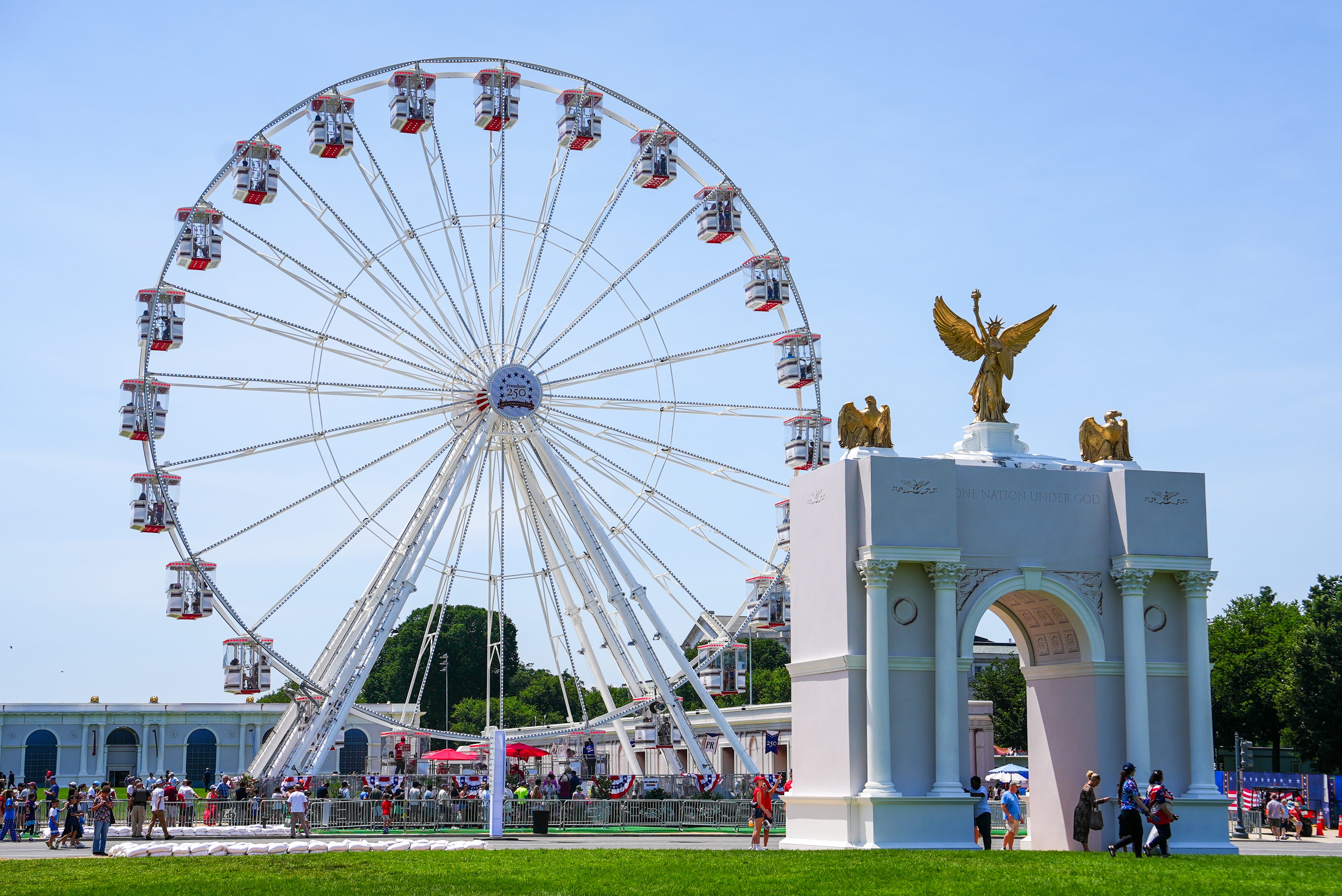
The fair occupied fifteen pale colonnaded structures that reframed the public spaces of the National Mall. Twelve sat on the gravel walkways on either side of the Mall’s grass. Three more elaborate buildings crossed the vista. Scattered between them were a few stages, a Ferris wheel, big exhibits, and a rodeo arena so small horses could not get up to a gallop. The heart of the entire ensemble was an arch topped by a gilded statue of victory who, for some reason, was wearing the crown of liberty. It was a miniature version of the arch Donald Trump wants to build between the Lincoln Memorial and Arlington Cemetery, albeit an earlier, and more Roman iteration of the design.
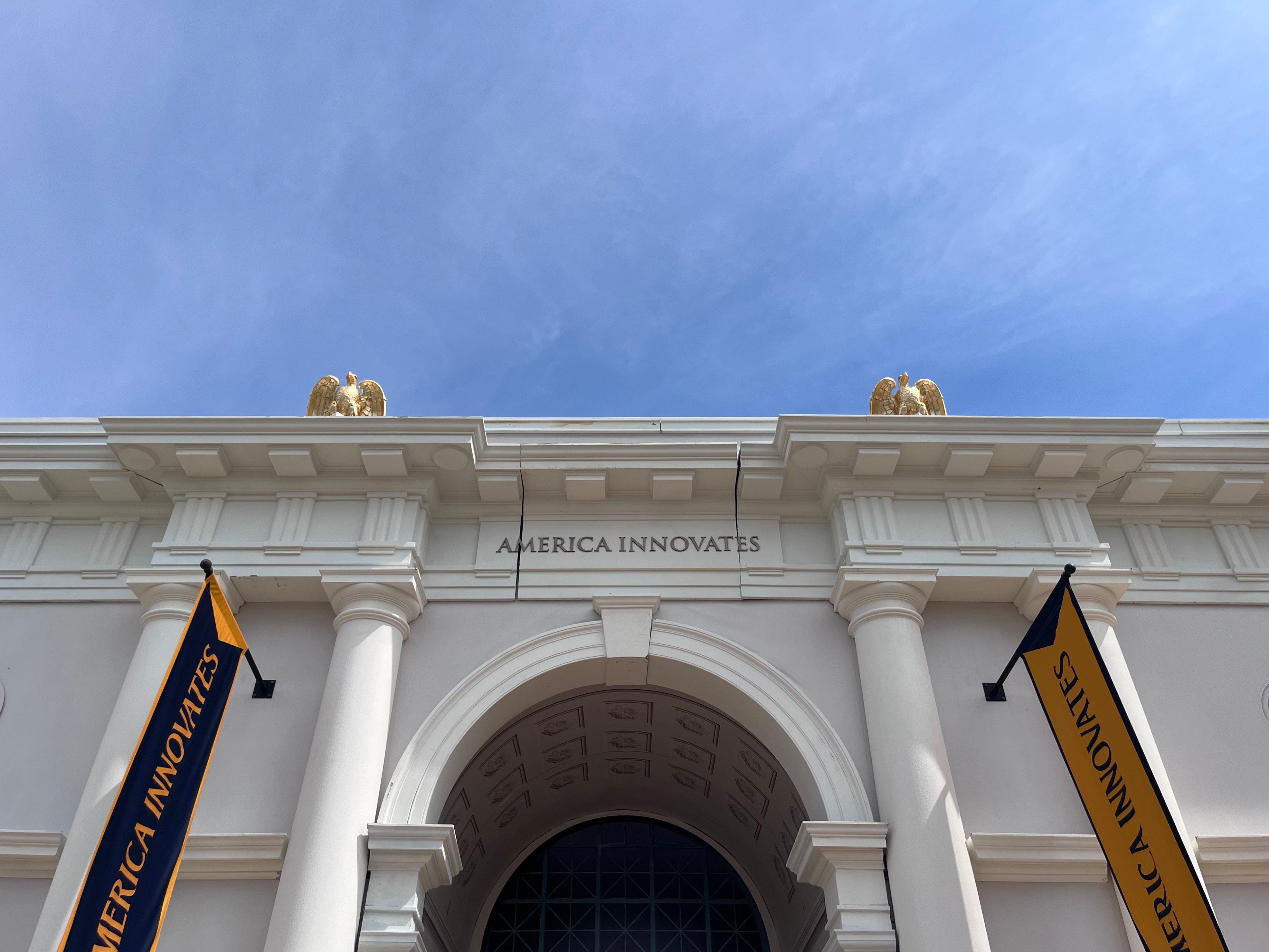
When it opened, however, most of the architectural detail hadn’t been installed. As the styrofoam ornaments arrived to flesh out the box made from PVC tent material, it only provided more opportunities to witness the sloppy construction, which were in evidence all over the fair. But contrary to a lot of assumptions I have seen on social media, it’s unlikely that the fair’s buildings were designed using AI. Instead, it was a clear case of a rushed job that exceeded the competence of the designer and fabricator. Someone—nobody has claimed the work—spent a lot of time designing these structures, thinking about the retro-future they represented.
What surely was on the creator’s pinboard were the monumental compositions of the City Beautiful movement. This was an episode around the turn of the 20th century that “saw middle- and upper-middle-class Americans attempt to refashion their cities into beautiful and functional entities,” in the words of its definitive historian, William H. Wilson. Its legacy in American cities was hard to overstate: the idea of clustering important buildings into civic centers, the concept of the parkway, the focus on order in American urban planning, the idea of beautification, and the National Mall itself—all come directly out of this brief surge of interest in imposing spatial harmony on cities that the wealthier half of the country found increasingly disturbing.
The movement and the State Fair share the same lodestars: the great World’s Fairs of the Gilded Age, particularly the Columbian Exposition held in Chicago in 1893. The great fairs up to then had been lavish displays of the unprecedented technological progress, economic growth, and imperial power of the countries that hosted them. Chicago offered something more. In a city considered to be a cultural backwater by a country that was anxious about its own cultural reputation, its designers wrapped the vast glass-and-steel exhibition halls in exuberant classical facades and arranged them around a lagoon into a complex called the Court of Honor.
Visitors—nearly a third of all Americans—were transported by this ensemble. Even today, its power to dazzle has made it the centerpiece of a conspiracy theory about a suppressed globe-spanning Tatarian Empire. Nobody understood its power more than artists and architects. According to the historian Jon Peterson, it offered them a vision of a poetic and ordered modernity, which came to be known as “civic art.” Usually realized in the method of classical design developed at the École des Beaux-arts in Paris, civic art became the most visible expression of a broader movement—one that was grappling with the social issues that emerged from American industrialization, immigration, and Gilded Age inequality.
As a result, that same public consciousness that underwrote these grand visions often found a lot to criticize about the movement. Progressives derided its focus on monumentality at the expense of the basics. To proponents of the parallel “city practical” and “municipal housekeeping” movements, the problems of cities were ones of sanitation, transit, good government, and moral betterment. To them, this civic art did nothing but create safe spaces for the egos of the business elite. Later, as the field of urban planning evolved from the movement and disengaged the public, the movement’s ideas became pillars of the top-down redevelopment that decimated American cities. As Jane Jacobs put it in her monumental book The Death and Life of Great American Cities, in seeking to force the “frosted pastries” of the 1893 World’s Fair onto urban complexity, planners turned cities into “sacrificial victims.”
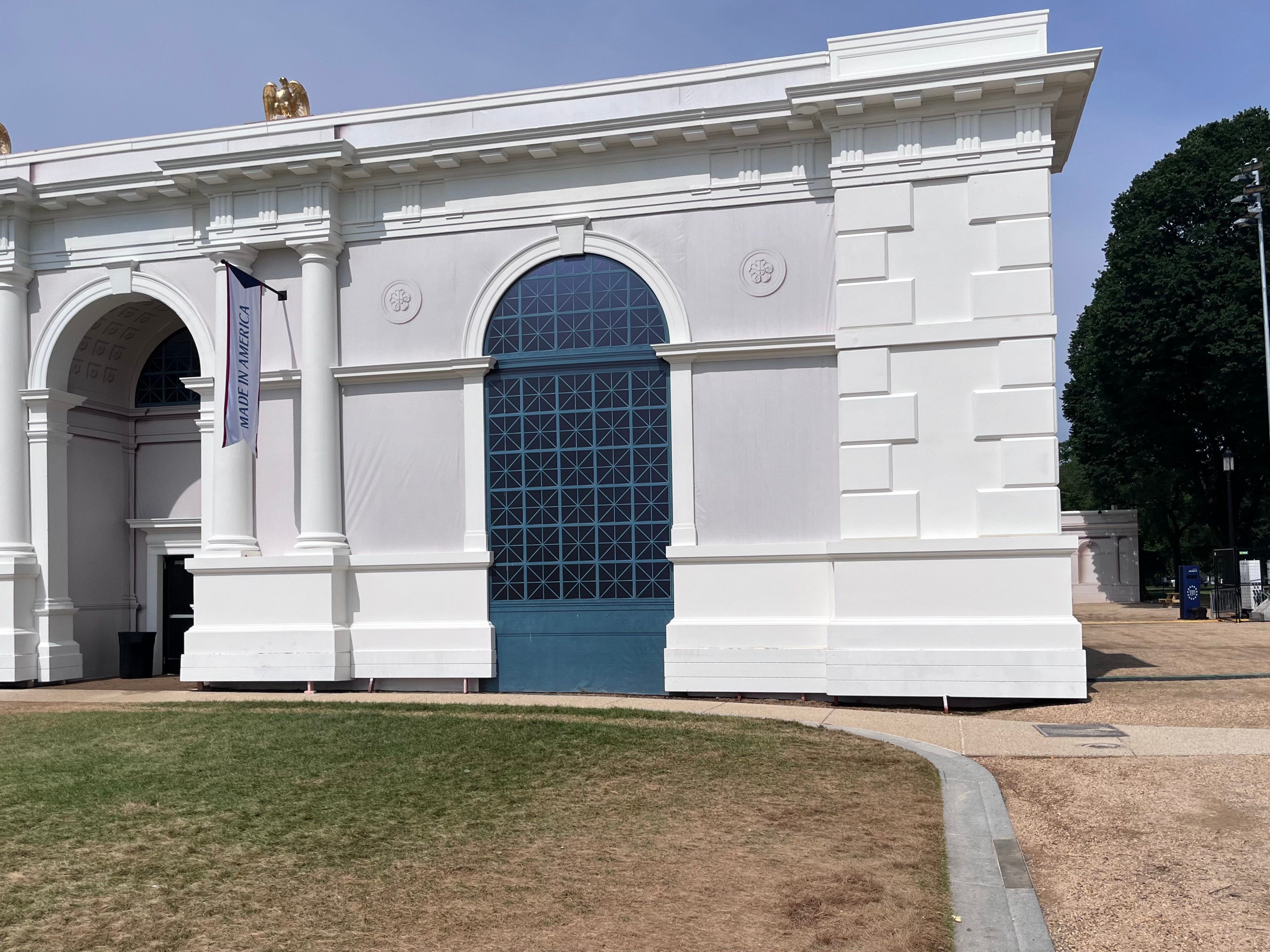
The same could be said of the semiquincentennial, in miniature and as a farce. In every way, a specific aesthetic vision took precedence over basic functions. Looking across a lawn toward one of the handful of facades that was complete, the illusion worked. The proportions are well-studied. Crisp cornices rested on soft tuscan pilasters. But where the 1893 fair could boast bright and airy, state-of-the-art spaces for its wonders, in 2026, organizers could only wrap windowless tents with the printouts of grand Roman windows. The shallow and often sparse exhibits inside were entirely artificially lit and cooled. This also meant that the spaces became unusable when the AC failed. Most other events on the Mall, like the Smithsonian Folklife Festival, have accepted the conditions of DC’s admittedly tough climate and work with them.
The design was similarly aloof to the constraints of the long, narrow site. At the state and agency pavilions on the side, visitors had to go in and out of each booth individually, walking along narrow sidewalks until they ran into a queue, another building, or the cattle chute. Indeed, the intelligent decision to break up the long, shadeless run of the Mall with attractions was ruined by the execution, which blocked each section from the next, visually and sometimes physically. This discontinuity was a basic failure of site circulation that would shock the luminaries of the City Beautiful movement as much as any promoter today. Worse, many of the facades hovered off of the ground, as if the designers did not realize that the National Mall was not flat. But of course it was not; almost no sites are. Ignoring this was the kind of smug carelessness most often seen on the backside of pretentious strip malls—not the Mall designed by Frederick Law Olmsted, Jr.
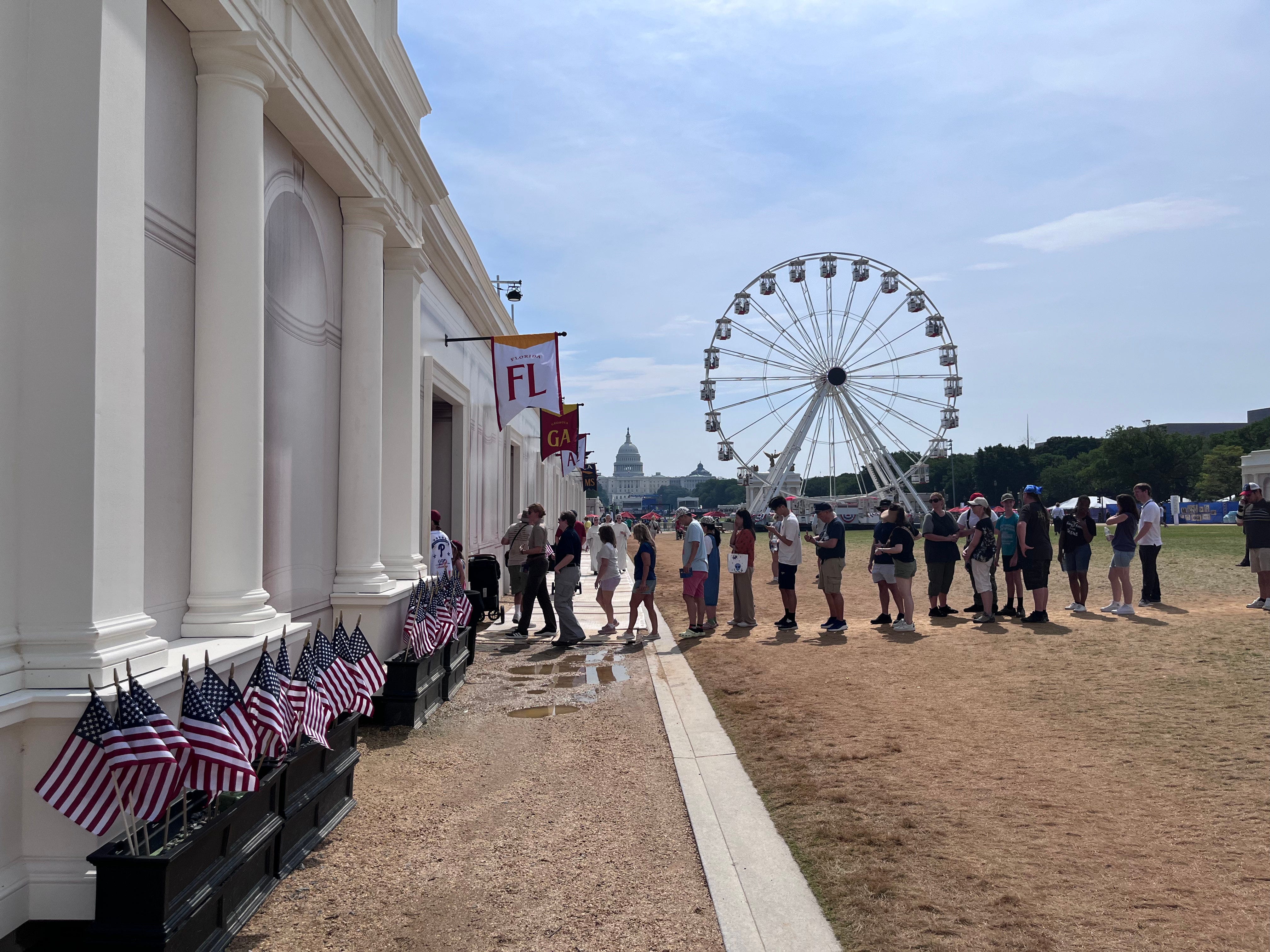
But more than anything else, the fair lacked what really underwrote the City Beautiful movement: an engaged public. Whereas the Chicago fair united business and civic groups, the Freedom 250 entity allegedly tossed a vast body of planning that was already underway and pursued a narrow vision of American promise—to say nothing of its wasp-waisted reinvention of history. Then, when the movement entered cities in the 1890s, promoters like Mira Lloyd Dock saw a mobilized public as not just a means to get sumptuous urban ensembles built, but an end itself. The fair instead treated the public as consumers of the American project at best and a menace to it at worst. Indeed, perhaps the most Trumpian features of the fair were the three fences between it and the city it occupies.
Perhaps, then, what the fair reveals instead was that an engaged public is a menace to the MAGA project. The same middle-class enthusiasm that created the City Beautiful movement eventually led to its demise, as activists increasingly subordinated the vision to Progressive policies like housing reform. By the 1909 Plan of Chicago, the grand visions had become a form of highbrow boosterism that did little more than stir men’s blood. The vision for America presented by the Great American State Fair can’t do any of that. In both its structures and exhibits, it promises a better future through a return to the past, but one in which the civic art shapes a compliant public, rather than an active public shaping the city. It might be more convincing if the styrofoam cornices were glued on straight, but it’s not a plan for greatness, either way.
Neil Flanagan is an author, architect, and native Washingtonian who is serving as scholar-in-residence at Heurich House Museum. He writes The Birth of a Capital, a newsletter about Washington DC, and is writing a book that uncovers the early 20th century politics that made the city leafy, monumental, and segregated.
Everything about that event was cheap and faux just like the administration it resembles.
The whole thing was such a waste of our money and a complete fiasco 🙄