


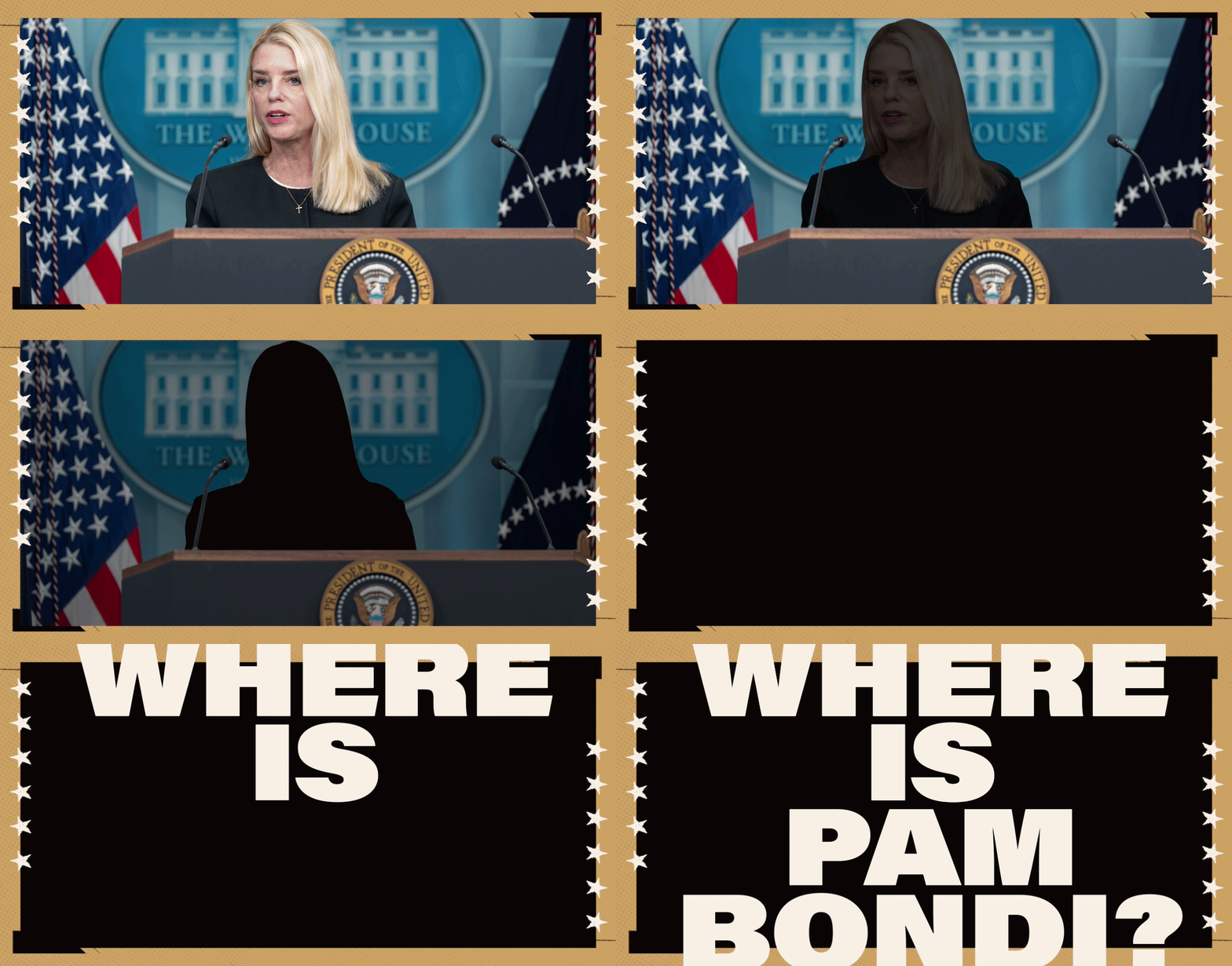
This article is part two of a series called The Epstein Administration, in which we break through the noise of the Epstein files, report the truth, and demand transparency and accountability. Read part one here.
Slinking Out
Tomorrow, April 14, former Attorney General Pam Bondi was scheduled to testify before the House Oversight Committee about her handling of the release of the Epstein files. After she was unceremoniously fired by President Trump on April 2 (at least in part because of her handling of the files), though, DOJ—miraculously!—relieved her of her duties to testify under oath about the investigation.
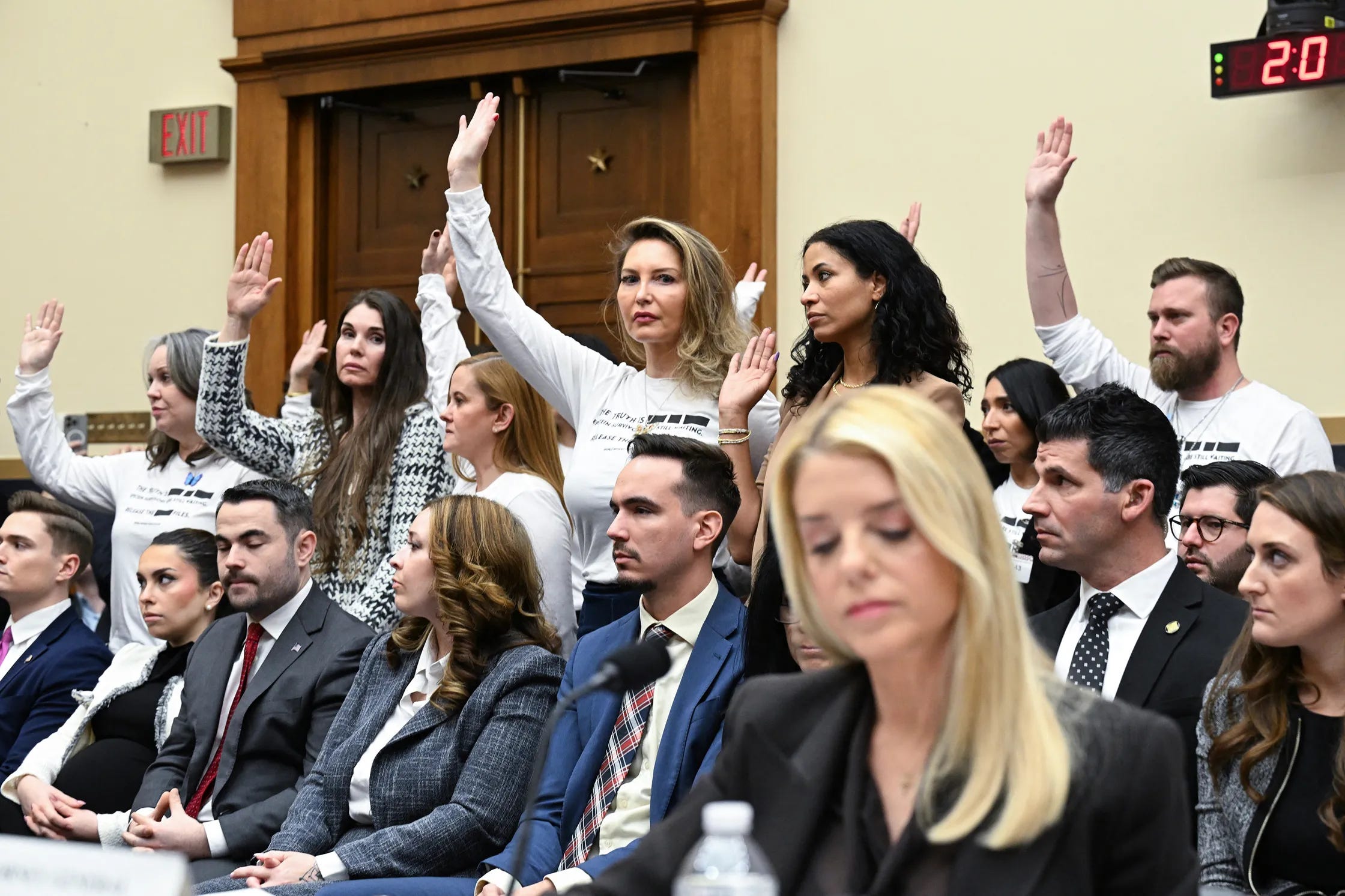
Her failure to testify tomorrow compounds the affront of her last appearance before Congress. Bondi spent the duration of her Epstein-related testimony in February ducking and weaving and bullying, completely unwilling to engage with questions either probing or banal. The hearing itself yielded no useful insights about her DOJ’s handling of the Epstein files but did provide the most emblematic image of the whole saga: the now infamous photo of Bondi refusing to acknowledge the survivors of Jeffrey Epstein’s abuse, much less issue an apology for her department’s release of their personal information:
It’s fitting that she’s the face and the scapegoat of the cover-up; the administration has Bondi to thank for the resurrection of the Epstein story in the first place. Following her confirmation as Attorney General—after alleged sex trafficker and first-choice pick Matt Gaetz withdrew from consideration—she teased on Fox News that she had the Epstein files “sitting on my desk” to review at the “directive” of “President Trump.” Since Bondi knocked over that first domino way back in February of 2025, the Trump administration has struggled to manage the Epstein story and done itself no favors by insisting that it’s a dead letter.
It was already a long shot, then, that Bondi would be any more forthcoming in the April 14 deposition than she was in February. But her absence is more telling about the future of the investigation going forward than her presence may have been. In a statement released by House Oversight Republicans, the reasoning offered for Bondi playing hooky is that “since she is no longer Attorney General and was subpoenaed in her capacity as Attorney General” she is no longer obligated to appear for questioning. Oversight Dems quickly refuted this, writing that “our bipartisan subpoena is to Pam Bondi, whether she is the Attorney General or not.”
The House Democrats are right. Bondi’s current title—or lack thereof—doesn’t change what she knows about the Epstein investigation or the release of the files. If anything, her ability to forgo testifying may be the silver lining of her sudden ouster from the Trump administration, for both her and the administration. What she knows will remain secret unless the House Republicans move to compel her testimony, which is unlikely. The more likely course—the Committee’s refusal to compel her appearance—will demonstrate, yet again, its indifference to unearthing any real or actionable insight about Epstein and his friends.
Unanswered Questions
It seems incomprehensible that an honest investigation by Congress (or DOJ) would not pursue every last answer from Bondi with urgency. If she had appeared for questioning tomorrow—or if she appears in the future (if the Committee follows through and subpoenas her in her “personal capacity”)—the public is entitled to answers from Bondi to at least the following questions:
A memo released by DOJ on July 7, 2025 states that “it is the determination of the Department of Justice and the Federal Bureau of Investigation that no further disclosure [on Epstein] would be appropriate or warranted.” Several months later, upon the nearly-unanimous passing of the Epstein Files Transparency Act (“EFTA”), DOJ released more than 3 million documents to the public. Why were these records deemed inappropriate for public disclosure in July? Were you involved in that determination? Who else was involved?
On July 23, 2025, the Wall Street Journal reported that “in May, Bondi and her deputy informed the president at a meeting in the White House that his name was in the Epstein files, the officials said. Many other high-profile figures were also named, Trump was told.” On July 25, 2025, President Trump was asked by reporters if he had been told that his name appeared in the Epstein files to which he replied, “No, I was never—never briefed, no.” Did you brief him about his name in the Epstein files in May or any other time?
Sen. Dick Durbin wrote in July that his “office was told that [FBI] personnel were instructed to ‘flag’ any records in which President Trump was mentioned.” Were these records flagged? If so, once flagged, what happened to these records? Were records mentioning Trump withheld? If so, how many such records have not been publicly released?
In September 2025, a White House official told the New York Times that “helping Thomas Massie and Liberal Democrats” with their “attention-seeking” discharge petition to compel a vote on the release of the Epstein files, “while the DOJ is fully supporting a more comprehensive file release effort from the Oversight Committee, would be viewed as a very hostile act to the [Trump] administration.” Did any of your conversations with the Trump White House provide insight into why they would have seen support of the Epstein Files Transparency Act as “hostile”? Did the president or anyone in his administration suggest that DOJ releasing more documents on Epstein was similarly “hostile”? What steps was DOJ taking in September 2025 to “[support] a more comprehensive file release effort”?
Did you, interim AG Todd Blanche, FBI Director Kash Patel, or anyone else at DOJ speak personally with President Trump about your rollout of the Epstein files at any point—either on their contents or manner of release? Did anyone speak with Susie Wiles? Stephen Miller? JD Vance? If so, did any White House personnel instruct DOJ on what files to release publicly (or not) or the process for doing so?
A 2015 memo released by DOJ revealed that Jeffrey Epstein was the subject of a years-long U.S. Drug Enforcement Administration investigation previously unknown to the public. When Sen. Ron Wyden sought an unredacted copy of the memo, he alleges that then Deputy Attorney General Todd Blanche moved to prevent the DEA from releasing the requested information. Why did Blanche intervene? Did he do so at your—or anyone else’s—behest?
On September 16, 2025, FBI Director Kash Patel said under oath that the government had “released all credible information” and that the review of the files had revealed “no credible information, none” that Epstein “trafficked to other individuals.” Likewise, the aforementioned July 2025 memo states that “we did not uncover evidence that could predicate an investigation against uncharged third parties.” Are you confident that the following men’s ties to Jeffrey Epstein were sufficiently investigated by previous Attorneys General: Andrew Mountbatten-Windsor, Donald Trump, Howard Lutnick, Jes Staley, Leslie Wexner, Leon Black?
When DOJ posted millions of Epstein-related documents more than a month after the EFTA mandated their release, one such document included an email exchange between Epstein and a redacted second party. In it, Epstein writes to the second party, “where are you? are you ok , I loved the torture video.” After congressional pressure, the second party was identified as Sultan Ahmed bin Sulayem. The EFTA mandates that “no record shall be withheld, delayed, or redacted on the basis of embarrassment, reputational harm, or political sensitivity, including to any government official, public figure, or foreign dignitary.” On what grounds was Sulayem’s name redacted? Was Sulayem or anyone questioned about the content of this email exchange?
Ghislaine Maxwell’s December 2025 habeas petition—filed from her new home, a minimum security prison—claims that “[c]onfidential settlements” were reached with “25 various men” in relation to Epstein’s abuse. Who are these 25 men, if they exist? Were some, all, or any of these men identified or investigated by your DOJ? Why, in your view, have none of the people previously investigated by federal authorities as potential co-conspirators been charged?
As Florida Attorney General, you worked to combat human trafficking with an emphasis on the sexual exploitation of women and children. During your tenure, you were quoted as saying that “human trafficking robs people of their dignity and deprives them of their most basic human rights.” You also listed the goals of your anti-trafficking initiative as the following: “make Florida a place with zero tolerance for human trafficking; to toughen state laws against offenders in line with federal statutes; and to increase criminal penalties for offenders [and] designate those convicted as sex traffickers as sexual offenders and predators known by all.” Your stated commitment to protecting victims of human trafficking is at odds with the experiences of Epstein survivors whose statement on your firing begins with “Attorney General Pam Bondi failed us.” What steps did you take as Attorney General to restore the “dignity” and “basic human rights” of the survivors of Epstein’s trafficking ring? Why didn’t you acknowledge the victims present during your February testimony?
Who Do You Serve?
As Attorney General, Bondi’s job was to represent the United States—not the president alone. After her firing, any residual fealty to Trump is interpersonal; her moral and legal obligation to survivors of Epstein’s abuse and to the American people is unchanged.
If House Oversight agrees, they should compel Bondi’s testimony and pursue a detailed line of questioning about DOJ’s operations under Bondi and the contents of the Epstein files. After all, she boasted about her Department’s transparency on the Epstein matter; answering questions, then, should be no trouble at all.
By letting her off the hook, House Oversight will demonstrate yet again that its investigation is searching only for politically expedient answers. Bondi—and by extension, Trump—remains protected by a Committee seemingly unwilling to probe unflattering information about the administration and its allies.
Bondi may be out, but the Trump-led cover-up of the Epstein files shows no sign of leaving with her. Not surprising, since it seems the strategy was never Bondi’s to begin with.
Shoes to Drop
Upcoming depositions to watch:
Tedd Waitt, former romantic partner of Ghislaine Maxwell: April 30, 2026
Howard Lutnick, Secretary of Commerce: May 6, 2026
Tova Noel, prison guard on duty at time of Epstein’s death: May 18, 2026
Lesley Groff, Epstein’s executive assistant covered by the 2008 non-prosecution agreement: June 9, 2026
Bill Gates, Co-Founder of Microsoft and acquaintance of Epstein: June 10, 2026
What questions do you still have about Bondi’s Epstein investigation? Share them in the comments below.
Home of the Brave exists to show Americans the real-world consequences of this administration’s policies, and to highlight what bravery looks like in defense of American democracy.
When will congress find some semblance of a spine? Arrest this bitch for contempt, then force her to testify under oath. When she lies [and she will] prosecute her for perjury and make it stick! Maybe the next smart-ass who considers refusing to testify will think twice!
She slithered back under the rock she came from.