


By Patricia Cronin
Last month the Trump administration put up signs outside the Smithsonian’s National Museum of American History warning the public that its exhibits don’t present American history as a shared national inheritance. This comes after a report from the White House’s Domestic Policy Council accused the museum of being insufficiently patriotic, and its director was grilled in a Congressional hearing for all sorts of alleged nefariousness, including “inaccurately” telling the story of the nation’s founders, casting the country in a negative light, and overemphasizing slavery, immigration, and transgender issues.
All of this is sheer lunacy. It’s also a deliberate strategy. Let’s call it what it is: an attempt to write certain people and perspectives out of the story. I know, because I’ve seen this happen before.
Twenty-five years ago, there were no public monuments to marriage equality to speak of. Our existence went unnoticed in the great public art of that era, just as our rights to marry and enjoy full legal equality went unrecognized. Public art mirrors the public sentiment of the day—who we honor, and who we ignore.
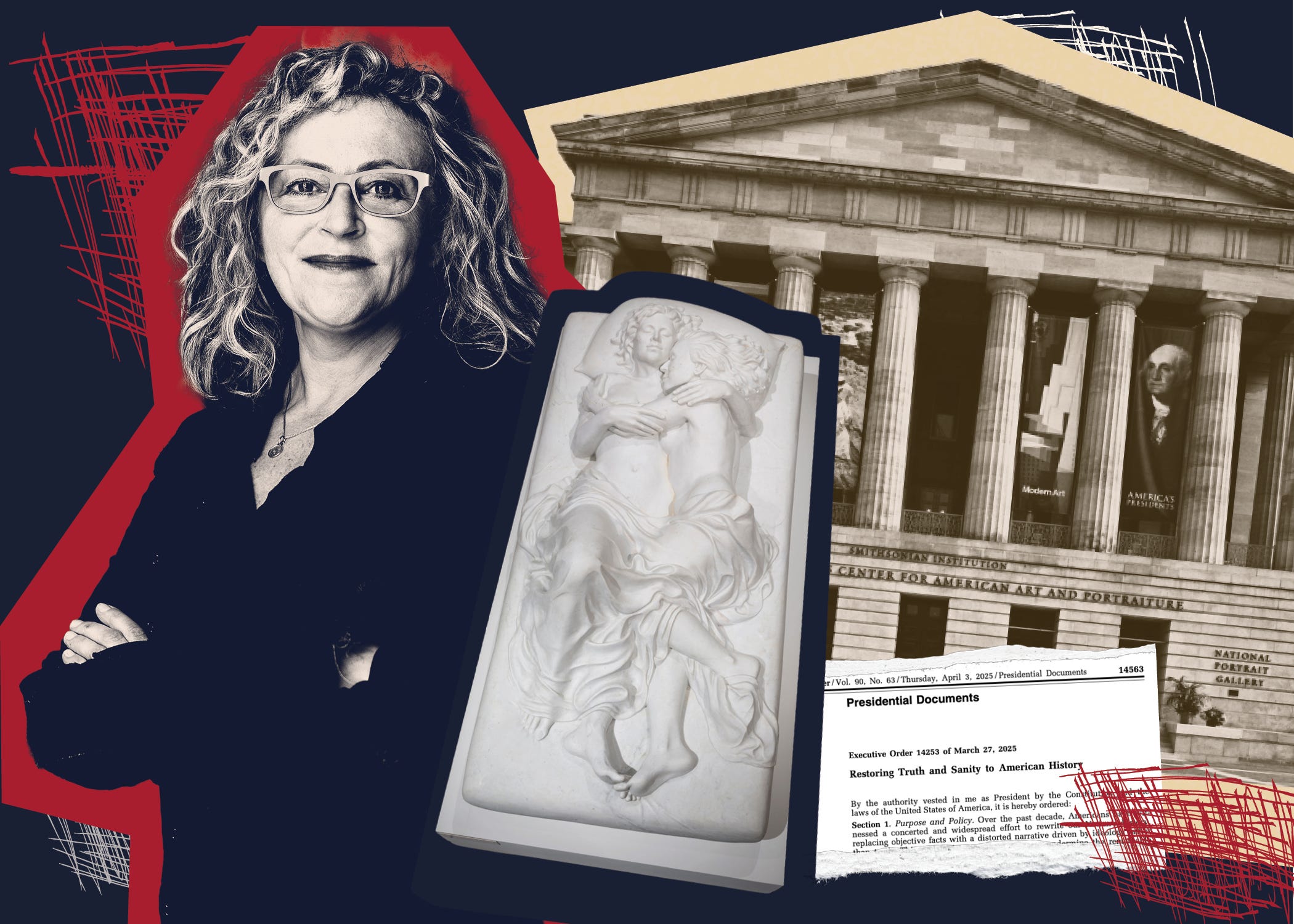
All of that is what led me to create Memorial to a Marriage. In 2002, it became the first marriage equality monument in the world: a three-ton homage to the LGBTQ women who have been disregarded for centuries, solidified in marble. This was a decade before the Supreme Court struck down the Defense of Marriage Act, and at the time, national support for marriage equality stood around 32 percent.
The art curator Helen Molesworth wrote that the statue “traffics in love and death, and in the intimate relations between these two structuring poles of human existence.” And art historian Robert Rosenblum called it “so imaginative a leap into an artist’s personal life and so revolutionary a monument in terms of social history that it demands a full scale monograph.”
Seeing this kind of reception for a work so personally meaningful was an honor that sticks with me to this day. It also reminds me that art is—must be—a living work that speaks to the spirit of the times. And when necessary, it must say something substantive to push back against the prevailing injustices in our society.
The original statue sits on my wife’s and my burial plot in Woodlawn Cemetery, but you can see bronze castings in museums across Europe, as well as in the Smithsonian National Portrait Gallery in Washington. As both an artist and a citizen, it’s hard to describe the feeling of knowing that your country’s premier national museum has chosen to showcase your work. I don’t say this to brag; I say it to highlight the positive effects that we as a society can realize when we choose to take the arts seriously, and reward them with the public support they deserve.
That’s why Donald Trump’s executive order on the arts last year broke my heart.
The order, called “Restoring Truth and Sanity to American History,” sought to remove any art deemed to be part of an un-American “ideology” from being displayed by the Smithsonian Institution. If that sounds Orwellian to you, that’s because it is. The state-led effort to determine which art counts as patriotic, and which doesn’t, necessarily opens up a Pandora’s box that can lead only to censorship—whether outright, or of a more subtle (though no less insidious character).
To be blunt, the order targeted any art that didn’t match Trump’s personal politics and worldview. Art like mine.
The subtext of the order was just as important as what was printed in black and white. With this order, the Trump administration telegraphed a message to every museum or arts institution in the United States: Don’t exhibit work that might displease the strongman. Don’t collect it. No research, no scholarship.
In the art world, many institutions rely wholly or in part on federal funding to keep afloat. For decades, we have simply taken it for granted that this support would remain constant, without interference from a petty, authoritarian-minded leader. But under this new order, the implication is clear: If you stick your head up above the parapet, you might not like the consequences. These are mob tactics: Nice art you’ve got there, shame if something were to happen.
Sure enough, that message has had a profound effect on both my freedom of expression and my livelihood.
Since this executive order, I’ve had two solo museum shows canceled—so far. After years working with these directors and curators, all of a sudden I’ve been told versions of: Oh, the director thinks this show doesn’t warrant our attention right now. But all these “not right now” messages from directors and curators have come after Trump’s second inauguration and after his executive order.
This is not a coincidence. This is censorship. Worse, it is a type of censorship that dare not speak its name. Institutions, understandably concerned about their own long-term viability, are being chilled into self-censoring what works they do and don’t exhibit, for fear of retaliation from a retributive, vindictive federal government. That is the real un-Americanism on display; not the works of art branded as such in Trump’s executive order.
Censorship is a form of intimidation. It’s inhumane, it’s disappointing, and it certainly isn’t democratic. When you censor the arts, one of our basic human expressions, you are trying to control the stories, the memories, and the values we set in stone (literally) for future generations.
And the trickle-down effect of censorship from the administration to the museums and their directors will eventually make its way down to the individual artists themselves, prompting them to self-censor in the studio. By stifling artists, the Trump administration is trying to find a way to control the national narrative and how its past, present, and future are presented. And I worry about how much of the American story will never be told because of the art that is never going to be made. That is what chills me to my bones.
But it’s not too late to raise our voices. Twenty-four years ago, I dared to create a work that celebrated LGBTQ love and unapologetically presented our inherent equality and humanity for all the world to see. Roughly a quarter-century later, and support for marriage equality has a clear majority of support. I am not suggesting that my work—or any one work—caused that change in our national character. But I am arguing that art—mine, and so many others’—has a vital, pivotal role to play in helping drive positive change across our society.
Trump’s executive order extols our “consistent progress toward becoming a more perfect Union.” But the order itself stands as a betrayal of that very progress. At the core of art is freedom. We cannot allow that to be taken from us.
Patricia Cronin is a Distinguished Professor of Art at Brooklyn College of The City University of New York and a New York-based artist whose work addresses sex, class and desire in painting, sculpture, and installation.
"With this order, the Trump administration telegraphed a message to every museum or arts institution in the United States: Don’t exhibit work that might displease the strongman." ... And there is a corollary message sent by the same order: DO exhibit "art" that pleases the stongman, like banners displaying his portrait on public buildings, rebranding public institutions with displays of his name, and desecrating national monuments to make way for celebrations of himself.
Threat to life, liberty, and the pursuit of happiness is not limited to bullets and bombs. Thank you for demonstrating courage in the face of threat and adversity to your creative abilities. A toxic personality is insecure and threatened by others’ perspectives and seek to snuff out any element of creativity that reflects a life of meaning and purpose.