


“A body of men holding themselves accountable to nobody ought not to be trusted by anybody.” – Thomas Paine
By George Retes
Last Wednesday, February 18, I officially launched my lawsuit against the federal government. For me, this was something that felt like it was never going to happen. Not because I didn’t want to or because I was afraid, but because I thought that was just the way the law works when you’re trying to hold federal officials—and the government that employs them—accountable for violating someone’s rights.
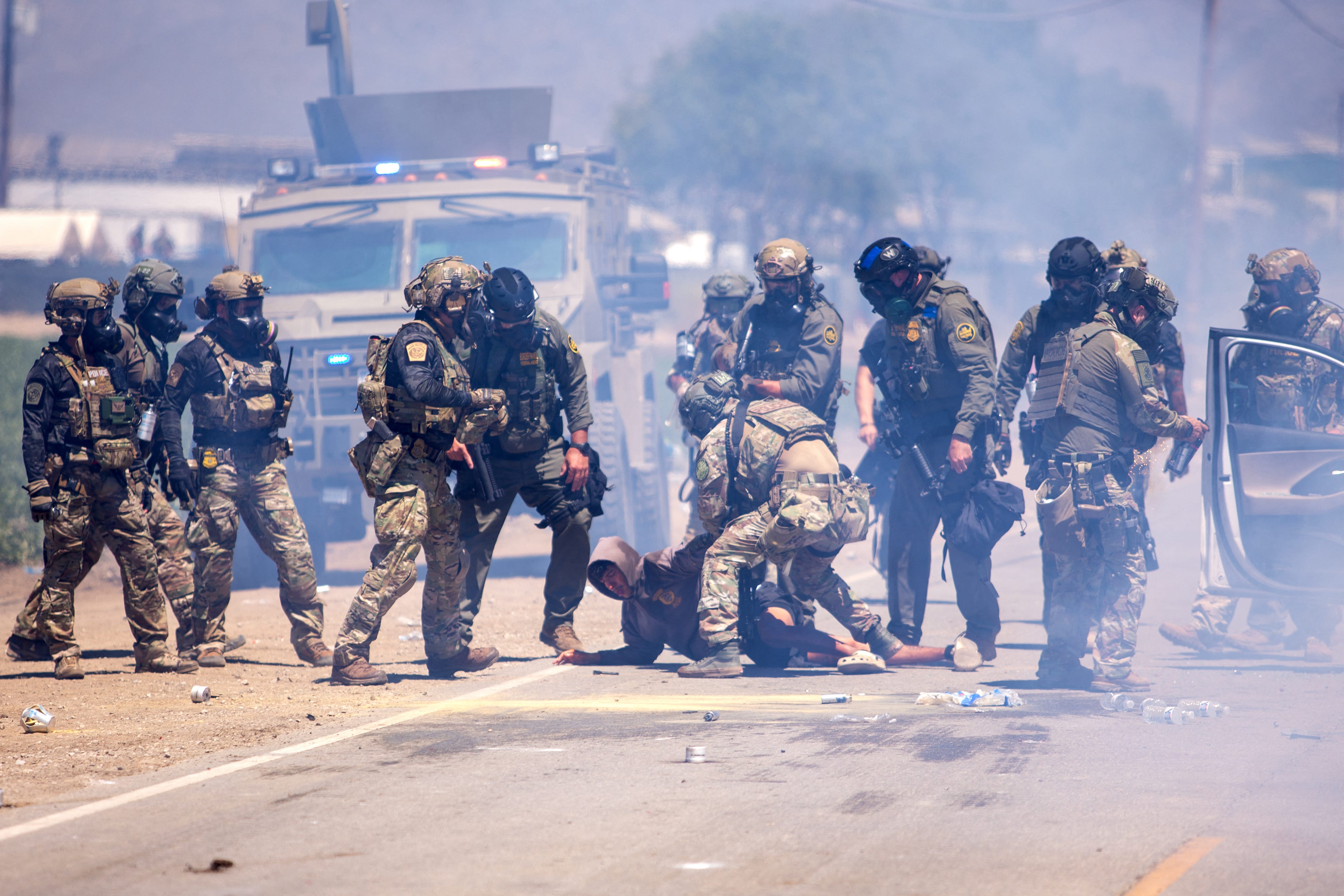
On July 10, 2025, I was driving to my job as a security guard at a licensed farm in Camarillo, CA. Federal immigration agents were lined across the road that led to the farm I worked at. I clearly stated my citizenship and fully complied with officers, even though they were all yelling contradictory orders and no one was clearly in charge. Yet, despite doing everything right, I was detained and treated as if I had no rights. Agents engulfed my car with tear gas, smashed my window, sprayed pepper spray in my face, and dragged me out. I was choking on gas, unable to breathe, and even though I wasn’t resisting, I had one agent kneeling on my back and another kneeling on my neck while my hands were already behind my back.
I was first taken to a Navy base, where the agents took my fingerprints, picture, and swabbed my DNA. I was then taken off the base to a detention center and held for three days without charges. No phone call. No lawyer. No medical care, even though my skin burned from the chemicals. I never even got to shower. Friday morning, I was put on suicide watch, which means they put me in a yellow concrete room with a concrete bed and tiny mattress on top. They left the light on 24/7. I was in a hospital gown, and a guard watched me. I was in those conditions from Friday morning to the point I was released. I was released with zero charges and no explanation for anything that happened.
After my release, the harm did not stop. Instead of correcting the record, officials from DHS, specifically DHS spokesperson Tricia McLaughlin, used social media to spread false and misleading statements about me, in an attempt to justify my detention and undermine my credibility.
I was wrongfully detained and then publicly misrepresented by the very agency that violated my rights. That is not transparency. That is damage control at the expense of the truth. And since they only respond through social media, I would like to ask them to answer these questions, not only to me, but to the world: Why didn’t I ever get a phone call? Or a shower? Or a lawyer? If your accusations are true, why was I released without charges?
Under a law called the Federal Tort Claims Act (FTCA), a person filing a lawsuit against the government must wait six months before they are even allowed to file suit. And even after all that, the chances of actually prevailing in your lawsuit are very low because of the so-called “discretionary function immunity” that the federal government gets. It is even harder to sue federal officials individually. Not because the court system is defending this, but because there is no clear law that allows people to sue individual federal officials for violating their rights.
There is another law that’s sadly relevant here: 42 USC 1983. As my attorneys wrote in Bloomberg Law, Section 1983 “allows constitutional claims to be brought against those acting under color of state law.” But, if, instead, an official is acting under color of federal law (which generally means an official working for the federal government), the result is “near-complete immunity from conventional lawsuits.”
All of that could be easily fixed by Congress. All Congress would have to do is amend the law to allow us to hold federal officials accountable for violating someone’s rights. The law already does this for state officials, so this change would be an easy fix that would hold all law enforcement to the same standards, implying that no one, no matter the badge, is above the law.
This week, I attended the State of the Union as a guest of Rep. Mark Takano (D-Calif.). I was honored and extremely grateful for the opportunity. Never did I think I would be in this situation, surrounded by these people, and yet here I was. By attending, I was a living reminder of government overreach and how it has impacted so many people, contrary to this administration’s claims that they are only going after “the worst of the worst.” I listened as the president painted DHS’s actions as appropriate simply because we need to fix the border issue. But this characterization is not true. This is not immigration enforcement; it’s madness.
When injustice becomes law, resistance becomes duty.
I’m fully aware that my lawsuit might fail; that the world might look at my story and choose to just move on; that the federal officials who did this to me might get off scot-free. But there’s another future possible here: one where we succeed in court, where people choose not to look away, where federal agents can’t unjustifiably detain a US citizen with impunity. That’s the future I choose to believe in, and the one I’m fighting to make real—not only for myself, but for every single person in this country.
What happened to me is not about politics. It is not about immigration policy. And it is not about one bad decision made in a chaotic moment. It is about power without accountability. If a US citizen, an Army veteran, someone who complied with officers’ directions, identified himself, and broke no law, can be treated this way—detained without charges, denied basic rights, physically restrained, and then publicly smeared to justify it—then no one in this country is as safe as they believe they are.
The Constitution does not only apply when it is convenient. Civil rights do not disappear because an agency makes a mistake. And truth does not stop mattering because it is uncomfortable. I am asking for accountability and my day in court, not just for myself, but for everyone who does not have a platform, a lawyer, or the ability to stand in front of you and tell their story. Because if this can happen to me, it can happen to anyone.
The measure of this country is not whether we admit when we are wrong, but whether we are willing to correct it.
George Retes is a US citizen and Army veteran who served in Iraq and was jailed by ICE and held for three days without an explanation.
Thank you for your bravery, your commitment to the truth, and your pursuit of justice on behalf of all of us, Mr. Retes. I am grateful.
Yes, thank you for your courage, bravery and truth-telling. Justice for you is justice for all of us. I have been so saddened and hurt by what this corrupt regime did to you. I'm glad you're alive and using the tools available to say no more.