


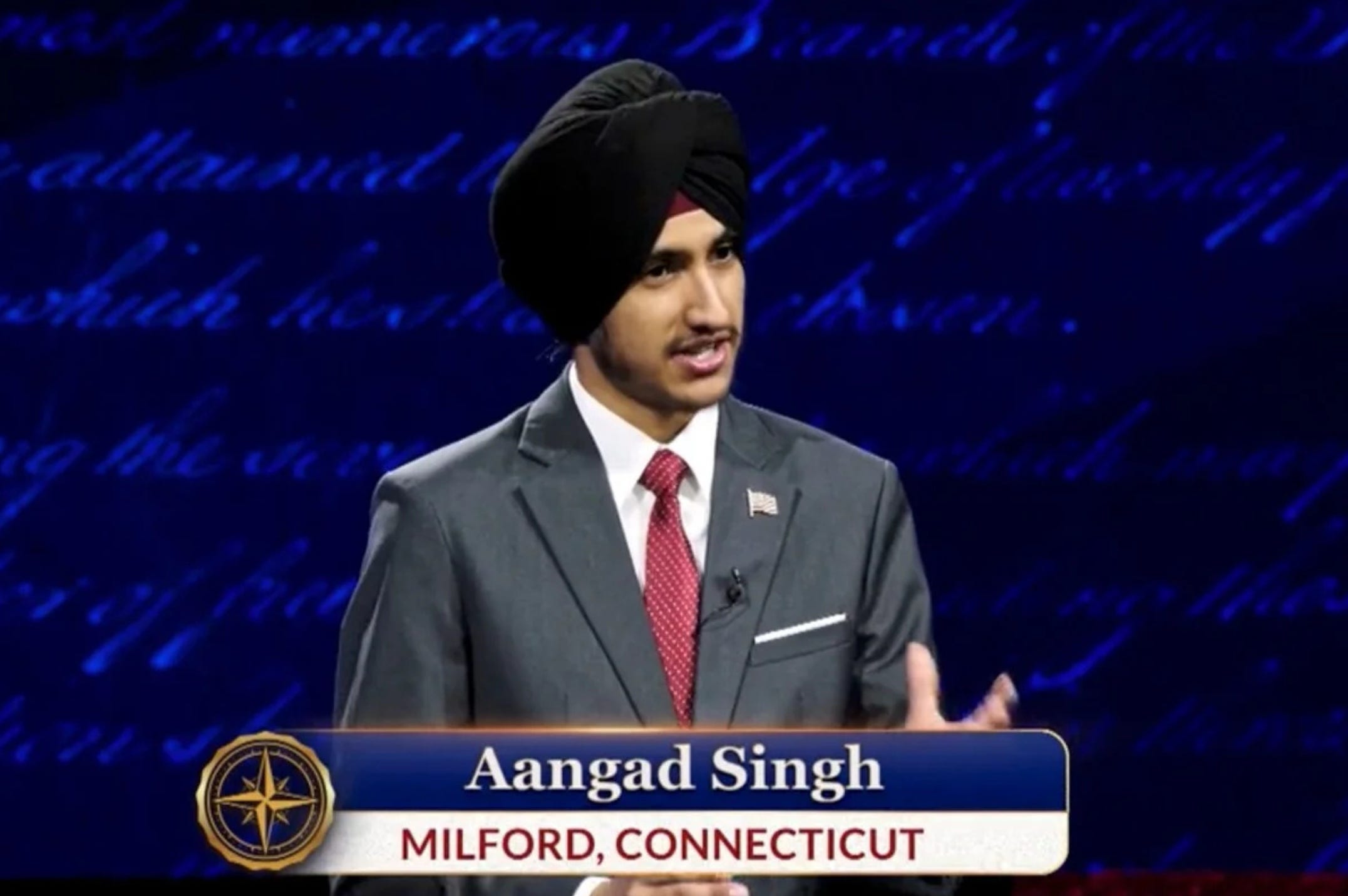
Aangad Singh knows way more about American government than most 15-year-olds—more than most Americans of all ages.
He knows so much, in fact, that he reached the national finals of the Presidential 1776 Award competition, a high school civics contest held through the Department of Education and President Trump’s Freedom 250 organization in honor of our nation’s 250th birthday. Wearing a gray suit with an American flag lapel pin, the Connecticut teenager was a dominant force on the Kennedy Center stage, nailing question after question. Out of 8,000 students from across the country, Aangad made it to the top eight.
Watching him gave me a flash of nostalgia for my time in high school quiz bowl, which culminated in a national championship in 2017. For a kid whose brand is their brain, and who maybe doesn’t excel in gym class, acing an academic trivia contest in front of a cheering crowd is exhilarating. Winning is all the more thrilling when you’re defying expectations. When I won my national final, I was the only girl on stage. When Aangad appeared in his, most of his fellow competitors were white.
But the magical thing about academic competitions is that if you get enough questions right, you win, and no one can argue you didn’t deserve victory. And the magical thing about America is that if you’re born here, or if you work hard to earn a place here—if you believe in the rights of life, liberty, and the pursuit of happiness and strive toward justice for all—you are American, and no one can argue you don’t belong.
That’s how it’s supposed to work, anyway. At the Presidential 1776 Award contest, things worked differently.
According to reporting from NOTUS this month, the competition audience thought Aangad was going to win. The judges’ scorekeeping wasn’t public, but one of his opponents told him, “You clearly knew everything.” Yet when host Mario Lopez announced the top three, Aangad wasn’t in it.
Instead, the top finishers were all white. One went to a private Catholic school, one was homeschooled, and one publicly adulated Trump before the contest and dreamed of attending Hillsdale College, an ultra-right-wing Christian school in Michigan. These students all worked hard, and should all be celebrated. However, by their own admission (per NOTUS), it sure seemed like Aangad knew more than them.
Aangad, the first-born, first-generation American child of parents from India, has devoted his childhood to American ideals. This spring, his speech about the Constitution won first place in his state’s American Legion Oratorical Contest. America’s given his family a lot. His parents did everything they could to give their children a good life, which meant moving halfway around the world to the United States for economic opportunities and quality education. They even gave Aangad a name starting with two ‘A’s so he’d always be at the beginning of school lists, according to the family. Despite their sacrifices, when their son missed the podium, they weren’t disappointed in him. They were just confused.
The competition website states that “all U.S. Department of Education and judge decisions are final and not open to appeal,” but Aangad’s family still wanted to understand. According to NOTUS, when his parents asked for the final scores, the government refused. So they did their own tally based on the June 30 CBS broadcast. By the end of the show, his parents’ calculations confirmed their suspicions: The judges had made a mistake. When red marks popped up on the television rejecting two of his answers, a dumbfounded Aangad pointed to the language in Article III of the Constitution proving that those answers were right. According to the family’s accounting, Aangad should have won. For the administration-appointed contest judges, being right hadn’t been enough.
If Aangad’s result wasn’t a verdict on his performance in the Presidential 1776 Award competition, it feels like a verdict on how the judges rated his American-ness.
In the United States, our national identity isn’t supposed to be based on bloodline. It’s supposed to be based on belief. We aren’t supposed to rank people’s American-ness here. No one is supposed to get extra points because of their background, their religion, or the color of their skin. Just because historically we’ve failed to live up to those ideals doesn’t make them any less essential. In fact, striving toward a more perfect union is one of the most American things we do.
The kids competing for this award—all of them—represent our highest hopes for America’s next 250 years. They are brilliant. They are diligent. And they love their country. Denying one of them the recognition he earned is a microcosm of this administration’s agenda. Striking Black officers from military promotion lists, trying to strip babies of their birthright citizenship, whitewashing American history, enabling and excusing ICE’s murders of civilians in the street: They’re all based on the idea that this administration gets to decide who really counts in this country. But keeping their scorecard hidden from the American public won’t trick us into believing their math.
Compared to deportations and drone strikes, maybe this whole story doesn’t seem like a big deal to you. The stakes are admittedly much lower. Besides, we don’t know if these mistakes were intentional or accidental. Maybe you think we should give the judges the benefit of the doubt and get over it. Aangad is smart. He’s already accomplished a lot, including making it to the final rounds of this very competition, and it seems like he has a lot more to look forward to in life.
But I can tell you from personal experience that for a bright high school kid trying to fit in, the stakes of academic competitions can feel infinite. According to a 2025 article from Pew, academic performance is by far the biggest source of stress for American teens, with nearly 70% reporting they feel pressure to earn high marks. Studies have consistently shown that many students suffer from impostor syndrome, reflecting pervasive self-doubt about their accomplishments. It’s easy to judge from the outside looking in, but while you’re in the thick of it, proving you’re smart feels life or death.
When I was studying for quiz bowl competitions, I’d sometimes stay up for 48 hours at a time. When I got a question wrong, that kept me up for nights, too. I lost weight. I had panic attacks. I started taking antidepressants to cope. And all of that was without a $150,000 scholarship, a trip to the White House, and my right to my own American identity on the line. (All I won was a little statuette.)
I pushed myself to the breaking point because I trusted that if I worked harder than everyone else, and crammed more information into my adolescent brain, I would be rewarded. That’s what’s supposed to happen in this country: If you’re exceptional, you succeed. We know it’s not always true, of course—but an academic competition is supposed to be different. It’s supposed to be a clear meritocracy. For Aangad, it wasn’t. And ironically, that’s fundamentally un-American.

The Trump administration has spread their xenophobic racism to all aspects of our society. You can bet this was just another example of it!
Shame